



EVGA
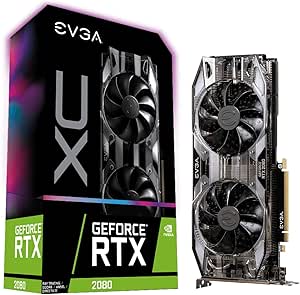
EVGA 08G-P4-2182-KR GeForce RTX 2080 XC Gaming Graphics Card
The RTX 2080 XC Gaming delivers Turing-generation ray tracing and 8GB GDDR6 bandwidth at a renewed price — full 1440p performance without paying for a current-gen card.
$264.97*$289.97Save 8%
View on Amazon
✓ In Stock on Amazon.com
*Price sourced from Amazon.com. Last updated:Sep 06, 2026.Price and availability are subject to change — details.
Affiliate Disclosure: As an Amazon Associate, Studio Supplies earns from qualifying purchases made through links on this page, at no additional cost to you. This helps support our editorial team.
Notice a mistake? Let Us Know
Overview
Key Features
Real Boost Clock: 1800 MegaHertZ; Memory Detail: 8192MB GDDR6. NVIDIA G SYNC Compatible
Dual HDB Fans and all new cooler offers higher performance cooling and much quieter acoustic noise
Adjustable RGB LED offers configuration options for all your PC lighting needs
Built for EVGA Precision X1, EVGA's all new tuning utility monitors your graphics card and gives you the power to overclock like a pro
3 Year *************************************************************.Get ************************************************************* Game + EVGA Vehicle Skin w/ purchase, redeemed at EVGA website, while supplies last
Specifications
Brand
EVGA
Model
08G-P4-2182-KR
GPU
GeForce RTX 2080 XC GAMING
Memory
8GB GDDR6
Memory Bus
256-bit
Memory Bandwidth
Up to 448 GB/s
Cooling
Dual HDB Fans
Lighting
RGB LED
Power Connectors
Dual 8-pin PCIe
Condition
Renewed
Similar Products
Other products from the same family that visitors often consider:
 Currently Unavailable
EVGA GeForce RTX 2080 XC Ultra Gaming Graphics Card
Check on Amazon → ✓ Available
EVGA GeForce RTX 2080 Ti XC ULTRA GAMING Renewed RGB Graphics Card
$389.97
View on Amazon → Currently Unavailable
EVGA GeForce RTX 3090 XC3 Gaming Graphics Card
Check on Amazon → Currently Unavailable
EVGA GeForce RTX 2080 Ti XC Hybrid Gaming - Renewed
Check on Amazon → ✓ Available
EVGA RTX 2080 XC2 Ultra Gaming Graphics Card
$799.00
View on Amazon →Frequently Asked Questions
What PCIe slot and power connectors does the RTX 2080 XC Gaming require?
The card uses a PCIe x16 slot and requires two 8-pin PCIe power connectors. Your PSU must supply at least 650W, and the connectors must come from separate rails where possible to avoid voltage sag under load.
What memory specification does the RTX 2080 XC Gaming carry?
The card runs 8GB of GDDR6 memory on a 256-bit bus, delivering up to 448 GB/s of memory bandwidth — sufficient for 1440p gaming at high settings and capable of driving 4K with moderated quality settings on most titles from this GPU generation.
Is this a new card or a renewed unit?
This is a professionally renewed card. The 08G-P4-2182-KR carries the same hardware as the original production unit — 8GB GDDR6, dual HDB fans, RGB LED — but has been inspected and tested to working condition before resale. Cosmetic and longevity condition vary.
Does the XC Gaming's factory overclock affect stability compared to the reference RTX 2080?
EVGA's XC boost clock sits above Nvidia's reference spec. In practice, the dual HDB fan cooler keeps the GPU well within thermal headroom, and EVGA validates the overclock at the factory — stability is not a meaningful concern under typical gaming loads.
Can I push the overclock further using EVGA Precision X1?
Yes. Precision X1 exposes core offset, memory frequency, power limit, and fan curve controls specific to this card. The 2080's GDDR6 bandwidth responds well to memory overclocking, which can yield measurable gains in bandwidth-limited titles.
What power supply and connector requirements does the RTX 2080 XC Gaming have?
The RTX 2080 requires dual 8-pin PCIe power connectors and a quality PSU — a 650W or higher unit with two dedicated 8-pin PCIe leads is recommended for stable operation under sustained gaming loads alongside a mid-to-high-tier CPU.
Does the RTX 2080 support hardware ray tracing and DLSS?
Yes — the Turing architecture features dedicated RT Cores for hardware-accelerated ray tracing and Tensor Cores for DLSS neural upscaling. Both are active in compatible game titles, differentiating this card from the GTX-class Pascal generation that preceded it.
Is this card compatible with G-Sync monitors, and does it support VR headsets?
Yes on both counts. The RTX 2080 supports G-Sync natively over DisplayPort, and its VR SLI and VirtualLink (USB-C) capability makes it compatible with first- and second-generation VR headsets.
What display outputs does the RTX 2080 XC Gaming provide?
The card offers three DisplayPort 1.4 outputs, one HDMI 2.0b port, and one USB-C (VirtualLink) port, supporting up to four simultaneous displays.
What PCIe slot does the RTX 2080 XC Gaming require?
The card requires a PCIe x16 slot. It will operate in PCIe 3.0 x16 slots found on most LGA1151, AM4, and later platforms, and is backward compatible with PCIe 2.0 x16 slots at reduced bandwidth — though PCIe bandwidth is rarely the bottleneck at this GPU tier.
Related Products


