



EVGA
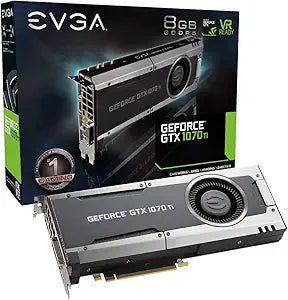
EVGA 08G-P4-5670-KR GTX 1070 Ti Gaming Graphics Card
GTX 1070 Ti Gaming delivers 1080p high-ultra headroom from 8GB GDDR5 and a 1683+ MHz boost clock, with one-click OC Scanner to push it further.
$720.00*
View on Amazon
✓ In Stock on Amazon.com
*Price sourced from Amazon.com. Last updated:Oct 24, 2026.Price and availability are subject to change — details.
Affiliate Disclosure: As an Amazon Associate, Studio Supplies earns from qualifying purchases made through links on this page, at no additional cost to you. This helps support our editorial team.
Notice a mistake? Let Us Know
Overview
Specifications
GPU Model
GTX 1070 Ti
Brand
EVGA
Memory
8GB
Similar Products
Other products from the same family that visitors often consider:
 ✓ Available
EVGA 08G-P4-6678-KR-cr GTX 1070 Ti Gaming Graphics Card Renewed
$134.97
View on Amazon → Currently Unavailable
EVGA 08G-P4-6178-KR GTX 1070 Hybrid Gaming Graphics Card
Check on Amazon → ✓ Available
EVGA GeForce GTX 980 Ti Gaming Graphics Card (Renewed)
View on Amazon → ✓ Available
EVGA 08G-P4-5171-KR GTX 1070 Gaming Graphics Card (Renewed)
$124.97
View on Amazon → Currently Unavailable
EVGA 843368045739 GTX 1070 Gaming 8GB Graphics Card
Check on Amazon →Frequently Asked Questions
What resolution and refresh rate is the GTX 1070 Ti Gaming realistically built for?
1080p at high to ultra settings is the native performance tier — the 8GB GDDR5 and 256-bit bus sustain strong frame rates at 1080p with headroom for 144Hz in less demanding titles. At 1440p, medium-to-high settings are achievable in most games. 4K gaming is possible in some titles but runs into bandwidth and VRAM ceilings in demanding scenes.
What does EVGA OC Scanner actually do?
OC Scanner automates the voltage-frequency curve optimization process. It stress-tests the GPU incrementally to find the maximum stable boost clock for your specific chip, generating a custom OC profile without requiring manual voltage and frequency tuning in Precision X1. Most chips yield 30-50 MHz of additional stable boost above stock.
Does the GTX 1070 Ti support DirectX 12 and Vulkan?
Yes. The Pascal GP104 die supports DX12 Feature Level 12_1 and Vulkan, with async compute enabled in hardware. Async shading improves frame pacing in DX12 and Vulkan titles that make use of asynchronous shader queues, where Pascal's architecture handles them more efficiently than Maxwell-generation cards.
Can this card still be used for GPU-accelerated content creation?
For CUDA-accelerated workloads in DaVinci Resolve, Premiere Pro, and Blender (CUDA render path), the GTX 1070 Ti's 2432 CUDA cores remain functional. However, it lacks RT cores (no OptiX hardware ray tracing) and Tensor cores (no AI denoising), so current GPU-accelerated pipelines that depend on those features will hit hard limits compared to RTX-generation cards.
What PSU wattage is recommended for a system running this card?
EVGA recommends a minimum 500W PSU. Confirm your power supply provides at least one 8-pin PCIe power connector — the card's TDP and boost behavior under OC load draw consistently from the power supply, and a marginal unit will thermal-throttle or cause instability under sustained load.
Related Products


