



EVGA
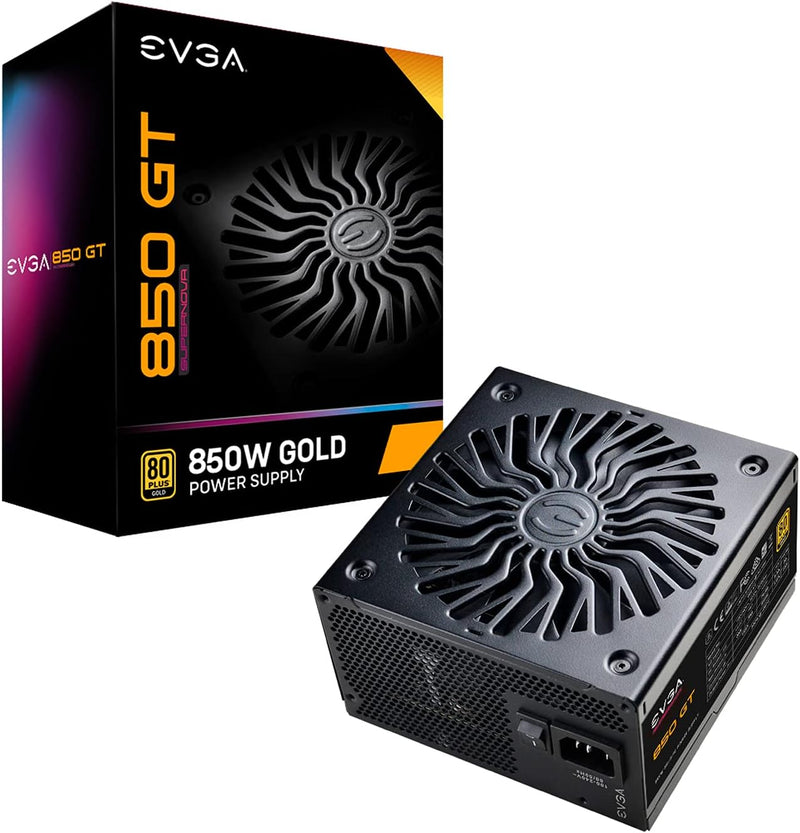
EVGA 220-GT-0850-Y1 850 GT 850W 80+ Gold Fully Modular Power Supply
850W80 PLUS Gold
850W of Gold-certified, fully modular power with Auto ECO Mode gives high-end single-GPU builds clean headroom without acoustic compromise.
$299.99*
Check availability
*Price sourced from Amazon.com. Last updated:Aug 27, 2026.Price and availability are subject to change — details.
Affiliate Disclosure: As an Amazon Associate, Studio Supplies earns from qualifying purchases made through links on this page, at no additional cost to you. This helps support our editorial team.
Notice a mistake? Let Us Know
Overview
Key Features
80 PLUS Gold certified, with 90% (115VAC) / 92% (220VAC~240VAC) efficiency or higher under typical loads
Fully Modular to reduce clutter and improve airflow
100% Japanese Capacitors plus OVP, UVP, OCP, OPP, SCP, and Dual OTP Protections
Fluid Dynamic Bearing Fan and EVGA Auto ECO Mode for ultra-quiet operation and increased lifespan
Specifications
Wattage
850W
Efficiency Certification
80 PLUS Gold (90% @ 115VAC / 92% @ 220–240VAC)
Modularity
Fully Modular
Fan Type
Fluid Dynamic Bearing (FDB)
Thermal Control
Auto ECO Mode (zero-RPM at low/medium loads)
Capacitors
100% Japanese
Protections
OVP, UVP, OCP, OPP, SCP, Dual OTP
Frequently Asked Questions
What is the efficiency rating of the 850 GT, and does it vary by input voltage?
Yes — the 850 GT achieves 90% efficiency at 115VAC and 92% at 220–240VAC under typical loads. The higher efficiency at 220V is a characteristic of the LLC resonant topology and is relevant for international users or those on split-phase 240V circuits.
Is the 850 GT single-rail or multi-rail on the +12V bus?
The 850 GT uses a single +12V rail, delivering the full rated current capacity to any connector without per-rail OCP limits that could nuisance-trip during GPU power spikes common in modern high-TDP cards.
What protection circuits are included, and what do the dual OTP circuits protect against?
The 850 GT includes OVP, UVP, OCP, OPP, SCP, and dual OTP (Over-Temperature Protection). The two OTP sensors monitor different thermal zones inside the PSU independently, shutting down before heat damage can occur — more robust than single-sensor designs.
Will this fit a standard ATX case, and what is the unit's depth?
It uses the standard ATX form factor. Specific depth dimensions should be confirmed against your case's PSU bay clearance — most mid-tower and full-tower cases accommodate EVGA GT-series units without modification.
How does Auto ECO Mode differ from the manual ECO Mode on some other EVGA models?
Auto ECO Mode dynamically manages the fan curve based on load and temperature without any user input or switch. At low-to-medium loads the fan stops entirely; it ramps up automatically as thermals demand it. There is no on/off toggle required.
Related Products


