



Gigabyte
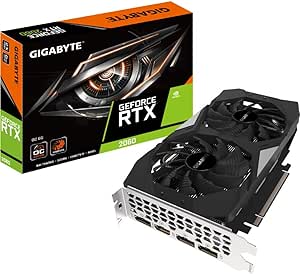
GIGABYTE GV-N2060OC-6GD RTX 2060 Windforce OC Graphics Card
DisplayPort
Factory-overclocked to 1755 MHz with 6GB GDDR6 on a 192-bit bus, the RTX 2060 Windforce OC delivers hardware ray tracing and DLSS at 1080p and 1440p.
$349.99*
View on Amazon
✓ In Stock on Amazon.com
*Price sourced from Amazon.com. Last updated:Sep 12, 2026.Price and availability are subject to change — details.
Affiliate Disclosure: As an Amazon Associate, Studio Supplies earns from qualifying purchases made through links on this page, at no additional cost to you. This helps support our editorial team.
Notice a mistake? Let Us Know
Overview
Key Features
Powered by GeForce RTX 2060
Nvidia Turing architecture & Real time Ray Tracing
Windforce 2x cooling system with alternate spinning fans
Intuitive controls with AORUS engine
Core Clock 1755 MHz
6GB 192-bit GDDR6
1 x HDMI, 3 x DisplayPort
Pci Express 3. 0 x16
Specifications
Model
GV-N2060OC-6GD REV2.0
GPU
GeForce RTX 2060
Architecture
NVIDIA Turing
Memory
6GB GDDR6
Memory Bus
192-bit
Core Clock
1755 MHz (Boost)
Cooling
Windforce 2X (Dual 80mm Fans, Alternate Spin)
Display Outputs
1x HDMI, 3x DisplayPort
Interface
PCI Express 3.0 x16
Similar Products
Other products from the same family that visitors often consider:
 ✓ Available
Gigabyte RTX 3080 Ti Gaming OC 12G - WINDFORCE Graphics Card
$1,149.99
View on Amazon → Currently Unavailable
Gigabyte RTX 3070 Eagle OC 8G Graphics Card
Check on Amazon → ✓ Available
Gigabyte GeForce RTX 2060 - 6GB Graphics Card - Renewed
$159.99
View on Amazon → Currently Unavailable
Gigabyte RTX 3090 Gaming OC 24GB Graphics Card
Check on Amazon → ✓ Available
Gigabyte RTX 3070 Ti Eagle 8G Graphics Card WINDFORCE
$795.00
View on Amazon →Frequently Asked Questions
Will this card fit in my case and work with my motherboard?
The GV-N2060OC-6GD uses a PCIe 3.0 x16 interface, fully backward compatible with PCIe 2.0 and forward compatible with PCIe 4.0 slots at no performance penalty. Physically, the Windforce 2X is a dual-slot design — verify your case has sufficient card length clearance before purchasing.
What PCIe slot and power connectors does the RTX 2060 Windforce OC require?
It uses a PCI Express 3.0 x16 slot and is fully compatible with PCIe 4.0 and 5.0 motherboards at x16 bandwidth. Power connector requirements for the RTX 2060 are typically one 8-pin connector — verify your PSU has the appropriate connector before installing.
What PSU wattage does the RTX 2060 Windforce OC require?
NVIDIA recommends a minimum 550W PSU for RTX 2060 builds. The GV-N2060OC-6GD draws supplemental power via a single 8-pin PCIe connector — ensure your PSU has adequate headroom alongside your CPU and other components at that wattage.
What does the 192-bit memory bus mean for gaming performance versus a 256-bit card?
The 192-bit bus width limits peak memory bandwidth to approximately 336 GB/s, compared to ~448 GB/s on a 256-bit card. In practice, this means the RTX 2060 performs best at 1080p and 1440p with high-quality settings — at 4K with maximum textures, the narrower bus becomes a constraint. For 1080p gaming, the bottleneck rarely surfaces.
How does the Windforce 2X cooling system work, and is it quiet?
Windforce 2X uses two 80mm fans with alternate spinning orientation — one fan spins clockwise, the other counter-clockwise — which reduces airflow turbulence between them and improves overall static pressure through the heatsink fins. Under load, the system is quieter than reference blower coolers; at idle and light loads, both fans can stop completely (semi-passive mode).
Do the Windforce 2X fans stop spinning at idle?
Yes — GIGABYTE's semi-passive cooling mode stops fan rotation below a thermal threshold during light desktop workloads. The fans spin up under gaming or rendering load. The alternate-spinning fan design reduces turbulence and improves static pressure through the heatsink fins under load.
What does the 192-bit memory bus width mean compared to other RTX cards?
The RTX 2060's 192-bit bus delivers approximately 336 GB/s of memory bandwidth from its 6GB GDDR6 pool. The RTX 2070 and above use a 256-bit bus — the narrower bus is a measurable constraint at 4K and with high-resolution texture assets, but it is not a bottleneck at 1080p or 1440p gaming resolutions.
Does the AORUS Engine software let me adjust the factory overclock?
Yes — AORUS Engine allows you to adjust core clock offset, memory clock offset, fan curve, and voltage (where unlocked). The factory core clock of 1755MHz can be pushed further on well-cooled specimens, though headroom varies by individual chip quality.
What display outputs are available, and can this card drive multiple monitors?
The card provides 1× HDMI and 3× DisplayPort outputs. You can drive up to four displays simultaneously — one per output. The HDMI port is suitable for TVs and monitors without DisplayPort; the three DisplayPort connectors support monitors up to 4K at high refresh rates.
Does this card support DLSS and hardware ray tracing?
Yes — the RTX 2060 includes dedicated Tensor cores for DLSS and RT cores for hardware ray tracing, both Turing architecture features. DLSS 2.0 support via driver updates enables meaningful frame rate recovery in supported titles. Hardware ray tracing is functional but demanding at higher quality presets given the 6GB VRAM ceiling.
Related Products


