

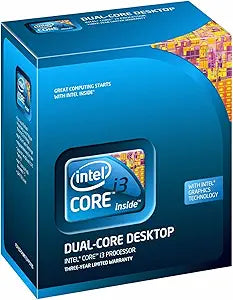
Intel
Intel BX80616I3530 Core i3-530 2.93 GHz Processor
73watt
The Intel Core i3-530 delivers 2.93GHz dual-core Hyper-Threaded performance with integrated Intel HD Graphics on the LGA1156 platform — a capable baseline processor for its generation.
$54.21*
View on Amazon
✓ In Stock on Amazon.com
*Price sourced from Amazon.com. Last updated:Oct 25, 2026.Price and availability are subject to change — details.
Affiliate Disclosure: As an Amazon Associate, Studio Supplies earns from qualifying purchases made through links on this page, at no additional cost to you. This helps support our editorial team.
Notice a mistake? Let Us Know
Overview
Key Features
2.93GHz Clock Speed
Intel HD graphics included
2 cores 4 threads with Intel Hyper-Threading
Socket LGA1156
73watt TDP
Specifications
Processor Model
Intel Core i3-530
Clock Speed
2.93 GHz
Cores
2
Threads
4
Graphics
Intel HD Graphics
Socket Type
LGA1156
Thermal Design Power (TDP)
73 watt
Similar Products
Other products from the same family that visitors often consider:
 Currently Unavailable
Intel X5570 Xeon 2.93GHz Quad Core Server Processor
Check on Amazon → ✓ Available
Intel BX80605I7870-cr Core i7-870 2.93 GHz LGA1156 Processor
$65.00
View on Amazon → ✓ Available
Intel Xeon W3540 Quad-Core 2.93GHz Processor
$299.00
View on Amazon → Currently Unavailable
Intel AT80602000765AA Xeon X5570 2.93 GHz Processor
Check on Amazon → Currently Unavailable
Intel 44T1887 Xeon X5570 2.93GHz Server Processor
Check on Amazon →Frequently Asked Questions
What socket does the Core i3-530 use, and which motherboards are compatible?
The i3-530 requires an LGA1156 socket motherboard. Compatible chipsets include Intel P55, H55, H57, and Q57. LGA1156 is a distinct socket from LGA1155 (Sandy Bridge) and LGA1366 (Bloomfield) — these are not cross-compatible. Verify your motherboard's socket specification before purchasing.
What socket does the i3-530 use, and what motherboards are compatible?
The i3-530 uses the LGA1156 socket, which is compatible with Intel H55, H57, P55, and Q57 chipset motherboards. LGA1156 is a discontinued platform — finding new motherboards is difficult, but used boards are widely available. It is not compatible with LGA1155, LGA1150, or any other Intel socket.
Does the i3-530 support ECC memory?
No. The i3-530 does not support ECC memory. It supports DDR3 at speeds up to 1333MHz in dual-channel configuration, with a maximum supported memory of 16GB across two channels. ECC support is reserved for Xeon processors on this platform generation.
What does Hyper-Threading on the i3-530 actually deliver for everyday tasks?
The i3-530 is a physical dual-core processor, but Intel's Hyper-Threading Technology presents 4 logical threads to the operating system. For applications that scale across threads — web browsers with multiple tabs, background file compression, multi-channel audio playback — this provides measurably more responsive multitasking than a 2-core/2-thread processor at the same clock speed.
What does Hyper-Threading add to a dual-core processor in practice?
Hyper-Threading exposes two logical threads per physical core — giving the i3-530 a total of 4 logical threads from 2 physical cores. This improves throughput in lightly-threaded multi-task scenarios (background downloads, office apps, audio playback) without changing single-threaded performance. Under heavy sustained load, the two physical cores remain the binding constraint.
What is the Intel HD Graphics core in the i3-530, and what does its 733MHz clock enable?
The integrated Intel HD Graphics in the Clarkdale i3-530 runs at 733MHz and supports DirectX 10. It is sufficient for Windows Aero desktop compositing, HD video playback via hardware decode, and basic display output up to 1920x1200. It is not a gaming GPU — 3D game performance is limited to titles with minimal geometry and effects budgets.
What is the i3-530's TDP, and what does that mean for cooler selection?
The i3-530 has a 73W TDP. The stock Intel cooler included in the box is rated for this TDP. Aftermarket coolers compatible with LGA1156 will also work, and for a system built in a small or poorly ventilated chassis, an aftermarket cooler with higher static pressure can reduce operating temperatures by 5–15°C under sustained load.
Does the i3-530 have an integrated GPU, and what display outputs does it support?
Yes. The i3-530 includes Intel HD Graphics clocked at 733MHz. Display output depends entirely on the motherboard — the iGPU signal passes through the board's video outputs (typically VGA or DVI on LGA1156 boards). The iGPU supports DirectX 10 and is sufficient for 1080p video playback and basic desktop work.
What is the thermal design of the i3-530, and does it run hot?
The i3-530 has a 73W TDP — moderate for its era. With an adequate stock cooler or any 95W-rated aftermarket LGA1156 cooler, it maintains stable temperatures under typical loads. In small form factor cases with poor airflow, thermal management requires attention at sustained full load.
Can the i3-530 be overclocked, and does it support Intel Turbo Boost?
The Core i3-530 does not support Intel Turbo Boost — that feature is reserved for Core i5 and Core i7 processors of this generation. The i3-530 also has a locked multiplier on most H55/P55 boards, meaning overclocking is limited to base clock (BCLK) adjustment, which also affects memory and PCIe timing and requires careful tuning to achieve stability.
Related Products


