

Intel
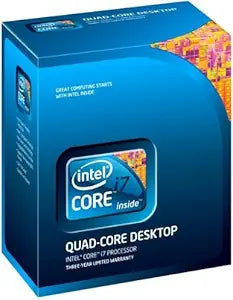
Intel BX80605I7870-cr Core i7-870 2.93 GHz LGA1156 Processor
Quad-core Nehalem architecture at 2.93GHz delivers the Turbo Boost headroom that made LGA1156 the performance sweet spot of its era.
$65.00*$163.04Save 60%
View on Amazon
✓ In Stock on Amazon.com
*Price sourced from Amazon.com. Last updated:Oct 21, 2026.Price and availability are subject to change — details.
Affiliate Disclosure: As an Amazon Associate, Studio Supplies earns from qualifying purchases made through links on this page, at no additional cost to you. This helps support our editorial team.
Notice a mistake? Let Us Know
Overview
Key Features
2.93 GHz core speed
Maximize speed for demanding applications with Intel Turbo Boost Technology, which accelerates processor clock speed up to 20% to match your workload.
Multitask up to 28% faster, so you can do more things at once.
Enjoy incredibly fast computing with fewer frustrating lags.
Unleash an amazing digital media experience with up to 37% faster conversion of video, 15% faster photo editing
Specifications
Processor Model
Core i7-870
Core Speed
2.93 GHz
Socket Type
LGA1156
Turbo Boost Technology
Up to 20% faster clock speed
Multitasking Performance
Up to 28% faster
Video Conversion Speed
Up to 37% faster
Photo Editing Speed
Up to 15% faster
Similar Products
Other products from the same family that visitors often consider:
 ✓ Available
Intel BX80616I3530 Core i3-530 2.93 GHz Processor
$44.93
View on Amazon → Currently Unavailable
Intel X5570 Xeon 2.93GHz Quad Core Server Processor
Check on Amazon → ✓ Available
Intel SLBTJ Core i5-650 3.2GHz LGA1156 Processor
$74.00
View on Amazon → ✓ Available
Intel BX80616I5670 Core i5-670 3.46GHz LGA1156 Processor
$104.62
View on Amazon → ✓ Available
Intel CM80616003174AH Core i5 650 Processor: 3.2 GHz, LGA1156
$108.70
View on Amazon →Frequently Asked Questions
What socket does the Core i7-870 use, and is it compatible with my existing motherboard?
LGA1156 exclusively. This socket is not cross-compatible with LGA1155 (Sandy Bridge) or LGA1366 (Extreme series) boards — verify your motherboard chipset is P55, H55, H57, or Q57 before purchasing.
What is Intel Turbo Boost and how much clock headroom does the i7-870 actually have?
Turbo Boost dynamically raises clock speed above the 2.93GHz base when thermal and power headroom allows. On the i7-870, it can boost up to 3.6GHz on a single core — a 23% uplift that matters for single-threaded workloads like lightly-threaded games or legacy software.
How many cores and threads does the i7-870 have, and does it support Hyper-Threading?
Four physical cores with Hyper-Threading enabled, presenting 8 logical threads to the OS. This makes it competitive for multi-threaded workloads like video encoding and rendering relative to its generation.
What is the TDP of the i7-870, and what cooler requirements does that impose?
95W TDP. The stock Intel cooler is adequate for moderate workloads, but sustained encoding or rendering sessions benefit from a quality aftermarket heatsink to maintain Turbo Boost states without thermal throttling.
Does the i7-870 support ECC memory or integrated graphics?
No to both. The i7-870 lacks an integrated GPU — a discrete graphics card is required. ECC memory is not supported; the processor is designed for standard DDR3 non-ECC DIMMs at speeds up to DDR3-1333 natively.
Related Products


