

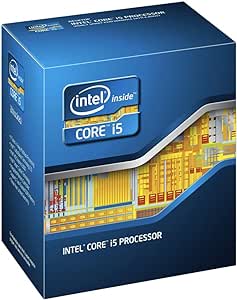
Intel
Intel BX80637I53450 Core i5-3450 Quad-Core CPU
i5-3450
Intel's Core i5-3450 quad-core hits 3.1 GHz base with Turbo Boost headroom to 3.5 GHz — reliable LGA 1155 CPU performance for budget builds and legacy platform upgrades.
$86.29*
View on Amazon
✓ In Stock on Amazon.com
*Price sourced from Amazon.com. Last updated:Oct 23, 2026.Price and availability are subject to change — details.
Affiliate Disclosure: As an Amazon Associate, Studio Supplies earns from qualifying purchases made through links on this page, at no additional cost to you. This helps support our editorial team.
Notice a mistake? Let Us Know
Overview
Key Features
3.10 GHz
6 MB L3 Cache
Turbo Boost Technology 2.0
Specifications
Processor
Intel Core i5-3450
Architecture
Ivy Bridge (22nm)
Core Count
4 (Quad-Core, no Hyper-Threading)
Base Clock
3.10 GHz
Turbo Boost (Max)
3.50 GHz
L3 Cache
6MB
Socket
LGA 1155
TDP
77W
Integrated Graphics
Intel HD Graphics 2500
Max Memory Support
32GB DDR3
Technology
Turbo Boost 2.0
Similar Products
Other products from the same family that visitors often consider:
 ✓ Available
Intel BX80623I72700K Core i7-2700K Quad-Core CPU
$292.82
View on Amazon → ✓ Available
Intel Core i7-2700K 3.50 GHz Quad-Core CPU
$675.00
View on Amazon → ✓ Available
Intel Core I5 4440 Quad-Core CPU Processor
$118.02
View on Amazon → ✓ Available
Intel BX80562QX6700 Core 2 Extreme QX6700 Quad-Core CPU
$49.88
View on Amazon → ✓ Available
Intel SR0PK Core i7-3770 3.4 GHz Quad-Core CPU
$51.99
View on Amazon →Frequently Asked Questions
What socket does the i5-3450 use, and which motherboards are compatible?
The i5-3450 uses the LGA 1155 socket, compatible with Intel 6-series (Sandy Bridge) and 7-series (Ivy Bridge) chipset motherboards — including H61, H67, Z68, B75, H77, Z77, and related variants. It is not compatible with LGA 1150, LGA 1151, or any later Intel socket. Verify your specific motherboard model supports Ivy Bridge CPUs, as some 6-series boards require a BIOS update.
What are the real-world clock speeds achievable with Turbo Boost on the i5-3450?
The i5-3450 has a 3.1 GHz base clock and boosts to 3.5 GHz on a single active core via Turbo Boost 2.0. All four cores are active for multi-threaded workloads; Turbo Boost frequency drops proportionally with core utilization. This is a locked multiplier CPU — overclocking is not supported on non-K chipsets.
How does the i5-3450's 6MB L3 cache affect performance versus the i5-3450S or i5-3470?
The i5-3450 shares 6MB L3 cache with the i5-3470 but runs at a slightly lower base clock. The cache size directly affects performance in cache-bound workloads — larger working data sets that fit in L3 avoid DRAM latency penalties. For most desktop tasks, the 6MB L3 provides adequate buffering for multi-threaded throughput.
Does the i5-3450 include integrated graphics, and what is supported?
Yes — the i5-3450 includes Intel HD Graphics 2500, supporting DirectX 11, H.264 hardware decode, and up to 1080p output. HD 2500 is the lower-tier integrated GPU in the Ivy Bridge lineup (HD 4000 is the higher tier), with reduced EU count. It handles basic display output and video playback but is not suitable for gaming or GPU-accelerated compute.
Does this CPU include a stock cooler, and is it adequate for sustained workloads?
The BX80637 retail box includes an Intel stock cooler — a standard aluminum heatsink with a push-pin fan. It is adequate for keeping the i5-3450 within thermal limits at box speeds during typical office and productivity workloads. For sustained encoding or gaming sessions, a 120mm tower cooler like the Cooler Master Hyper 212 will improve thermal headroom and reduce fan noise.
Related Products


