



Intel
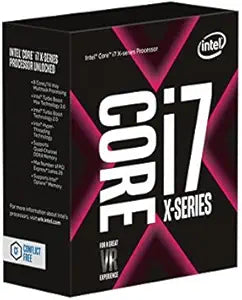
Intel BX80673I77820X Core i7-7820X 3.6GHz 8-Core Processor
Eight Skylake-X cores at 3.6 GHz base on LGA-2066 give content creators and heavy multitaskers a quad-channel memory pipeline that mainstream platforms can't touch.
$299.00*
View on Amazon
✓ In Stock on Amazon.com
*Price sourced from Amazon.com. Last updated:Oct 21, 2026.Price and availability are subject to change — details.
Affiliate Disclosure: As an Amazon Associate, Studio Supplies earns from qualifying purchases made through links on this page, at no additional cost to you. This helps support our editorial team.
Notice a mistake? Let Us Know
Overview
Specifications
Processor Family
Intel Core i7 (Skylake-X)
Model
i7-7820X
Core Count
8 cores / 16 threads
Base Clock
3.60 GHz
Socket
LGA-2066 (Socket R4)
L3 Cache
8 MB
Memory Support
Quad-Channel DDR4
PCIe Lanes
44 (PCIe 3.0)
TDP
140W
Chipset Compatibility
Intel X299
Integrated Graphics
None
Cooler Included
No
Similar Products
Other products from the same family that visitors often consider:
 ✓ Available
Intel BX80673I77820X Core i7-7820X Processor
$65.00
View on Amazon → ✓ Available
Intel BX80673I77820X Core i7-7820X X-Series Processor
$304.99
View on Amazon → ✓ Available
Intel BX80644E52640V3 Xeon E5-2640 v3 2.6GHz 8-Core Processor
$65.00
View on Amazon → ✓ Available
Intel BX8070110850K Core i9-10850K 3.6GHz Processor
$382.59
View on Amazon → ✓ Available
Intel BX80646I34350 Core i3-4350 3.6GHz Processor
$199.88
View on Amazon →Frequently Asked Questions
What socket does the i7-7820X use, and which motherboards are compatible?
The i7-7820X uses Intel LGA-2066 (Socket R4). It requires an X299 chipset motherboard. It is not compatible with LGA-1151, LGA-2011, or any other socket — the physical layout and pin configuration are unique to the HEDT platform.
Does the i7-7820X support quad-channel memory, and what does that mean in practice?
Yes. LGA-2066 paired with an X299 board provides quad-channel DDR4 bandwidth, roughly doubling memory throughput compared to the dual-channel configuration of mainstream LGA-1151 platforms. This directly benefits memory-bandwidth-bound workloads: video encoding, 3D rendering, large dataset processing, and simultaneous multi-stream applications.
What is the Turbo Boost frequency on the i7-7820X?
The i7-7820X boosts to 4.5 GHz on a single core via Turbo Boost 3.0 (Max Turbo). All-core boost varies depending on cooling and power delivery, but typically lands around 4.0–4.3 GHz under sustained multi-threaded load. The base clock is 3.6 GHz across all 8 cores.
Is the i7-7820X still viable for a workstation build today?
For lightly threaded tasks, it has been surpassed by modern architectures with higher IPC. However, for heavily multi-threaded workflows — particularly those that also benefit from high PCIe lane count (44 lanes) and quad-channel memory — it remains capable and can be acquired at significantly lower cost than current-gen equivalents.
Does the i7-7820X include a stock cooler?
No. Intel's HEDT processors ship without a cooler. A capable aftermarket cooler is required — at minimum a 240mm AIO or a high-performance air cooler. The 140W TDP means thermal management is a serious design consideration.
Related Products


