



Intel
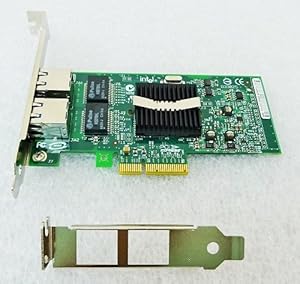
Intel Pro/1000 PT Dual Port Server Adapter
Dual-port Gigabit Ethernet delivers 2Gbps of server connectivity with Intel's proven PRO/1000 reliability on a single PCIe card.
$45.00*
View on Amazon
✓ In Stock on Amazon.com
*Price sourced from Amazon.com. Last updated:Oct 07, 2026.Price and availability are subject to change — details.
Affiliate Disclosure: As an Amazon Associate, Studio Supplies earns from qualifying purchases made through links on this page, at no additional cost to you. This helps support our editorial team.
Notice a mistake? Let Us Know
Overview
Key Features
Manufacturer Intel
Form Factor: Plug-in card
Connectivity Technology: Wired
Cabling Type: Ethernet 10Base-T, Ethernet 100Base-TX, Ethernet 1000Base-T
Data Transfer Rate: 1 Gbps
Specifications
Brand
Intel
Model
Pro/1000 PT
Ports
2× RJ-45
Data Transfer Rate
1 Gbps per port
Cabling Type
Ethernet 10Base-T / 100Base-TX / 1000Base-T
Connectivity
Wired
Form Factor
Plug-in card (PCI)
Frequently Asked Questions
What interface does this card use and which servers is it compatible with?
The Intel Pro/1000 PT uses a PCI Express interface. It is compatible with any server or workstation motherboard featuring a PCIe slot with sufficient lane width. The card supports 10Base-T, 100Base-TX, and 1000Base-T auto-negotiation, so it will operate correctly at whatever speed the connected switch port supports.
What bottleneck does a dual-port card solve versus two single-port cards?
A single PCIe slot hosts both ports, conserving expansion slots in slot-constrained server chassis. More practically, both ports share the PCIe bus bandwidth but can be configured for either link aggregation (up to 2Gbps combined throughput) or failover redundancy — the latter being the primary use case in server environments where uptime is the priority.
Does this card support hardware offloading to reduce CPU overhead?
Intel's PRO/1000 PT supports TCP/IP checksum offloading and large send offload (LSO), which reduces the CPU cycles consumed by network stack processing. In high-throughput server environments, this offload capability measurably reduces CPU utilization compared to software-only network processing on integrated NICs.
What operating systems provide native driver support for this card?
Intel provides drivers for Windows Server, Linux (kernel drivers are included natively for most distributions), and VMware ESXi. The PRO/1000 PT is a well-documented and widely deployed adapter, making driver availability broadly stable across server operating systems including legacy environments.
Can this card be used for iSCSI or PXE boot in a server environment?
Yes. The Intel PRO/1000 PT supports PXE network boot natively, which is standard for server provisioning environments. iSCSI initiator support is available through the operating system software stack; the card's hardware offloading can reduce CPU overhead for iSCSI traffic.
Related Products


