

MSI
MSI IM-PV-C DDR3 800 Socket P ATX Motherboard
An Intel Atom D525 onboard Mini-ITX platform that packs dual Gigabit Ethernet and five serial ports into a compact embedded computing foundation.
Check availability
Affiliate Disclosure: As an Amazon Associate, Studio Supplies earns from qualifying purchases made through links on this page, at no additional cost to you. This helps support our editorial team.
Notice a mistake? Let Us Know
Overview
Key Features
CPU (Included): Intel Atom D525 Processor
Chipset: North Bridge Intel NM10 & South Bridge?ICH8M
Memory: 2x DDR3-800 SODIMM Slots,?Single Channel,? Max Capacity of 4GB
Slots: 1x Mini PCI-Express Slot, 1x PCI Slot
SATA: 3x SATA2 Ports
LAN: Intel 82574L and Intel 82567V Gigabit Ethernet Controllers
Video: Intel GMA 3150 Graphics Controller
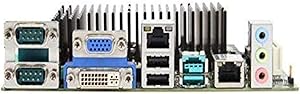
Ports: 8x USB 2.0Ports (4 rear,4 via headers), 5x Serial Ports (2 rear,3 via headers), 1xVGA Port, 1xDVI-I Port, 2x RJ45 LAN Ports, Audio I/O Jacks
Specifications
Processor
Intel Atom D525, Dual-Core, 1.8GHz (soldered)
Chipset
Intel NM10 (North Bridge) / ICH8M (South Bridge)
Memory
2x DDR3-800 SODIMM, Single-Channel, Max 4GB
Expansion Slots
1x Mini PCI-Express, 1x PCI
Storage
3x SATA2
LAN
Intel 82574L + Intel 82567V (Dual Gigabit Ethernet)
Video
Intel GMA 3150 (Integrated); VGA + DVI-I outputs
USB
8x USB 2.0 (4 rear, 4 via headers)
Serial Ports
5x Serial (2 rear, 3 via headers)
Form Factor
Mini-ITX
Frequently Asked Questions
Is the Intel Atom D525 processor soldered onto this board or socketed?
The D525 is soldered directly to the board — it is not upgradeable. At 1.8GHz dual-core with Hyper-Threading, this processor is permanently fixed to the platform, so CPU performance is a hard ceiling. Plan your workload around this constraint before purchasing.
What is the maximum RAM this board supports and what type does it require?
The board accepts up to 4GB total across two SODIMM slots running DDR3-800 in single-channel configuration. Single-channel means memory bandwidth is half what a dual-channel platform would deliver, which is appropriate for the D525's modest compute throughput but should be factored in for any memory-bandwidth-sensitive applications.
Why does this board have two separate Gigabit Ethernet controllers?
The dual LAN configuration — Intel 82574L and Intel 82567V — is specifically designed for network appliance use cases such as firewalls, routers, VPN gateways, and traffic monitoring systems where you need physically separate ingress and egress network paths. This is not a feature you'd find on a standard desktop motherboard.
What expansion options does this board offer for adding hardware?
The board provides one Mini PCI-Express slot and one full-size PCI slot. The Mini PCIe is typically used for wireless cards or additional storage controllers; the PCI slot supports legacy expansion cards. There are no PCIe x4 or x16 slots, so GPU acceleration and high-bandwidth add-in cards are not viable on this platform.
What operating systems are compatible with this board?
The Intel NM10 chipset and D525 processor have broad Linux support, making this platform well-suited for lightweight Linux distributions used in embedded and appliance deployments. Windows support is limited to older versions compatible with the Atom architecture; the integrated GMA 3150 graphics has limited driver support on Windows 10 and later.
Related Products

