



MSI
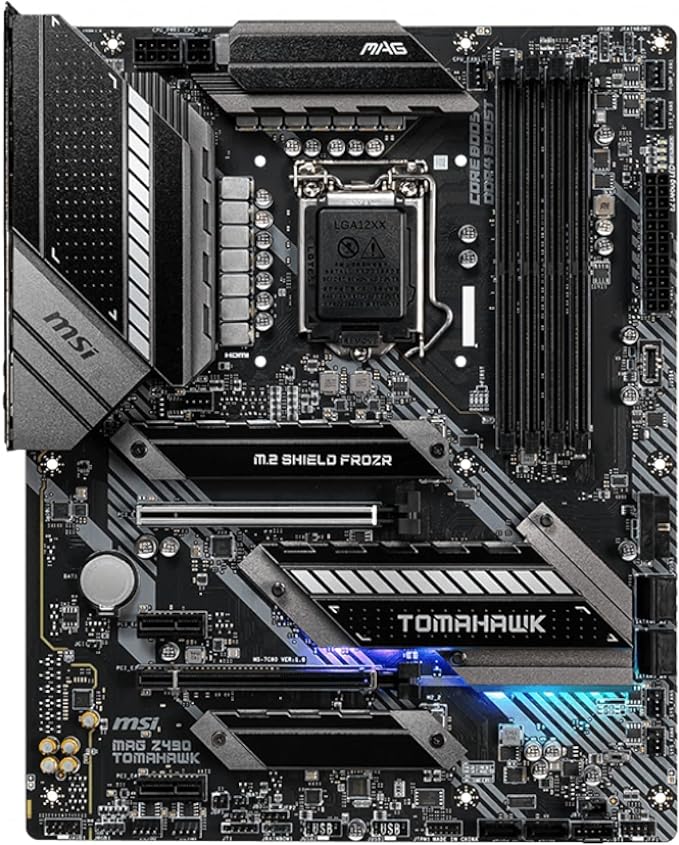
MSI MAG Z490 Tomahawk ATX Gaming Motherboard
The Z490 Tomahawk delivers a feature-complete 10th Gen Intel platform with dual shielded M.2, USB 3.2 Gen 2x2, and 2.5G LAN at a price that doesn't demand a flagship tax.
$419.00*
View on Amazon
✓ In Stock on Amazon.com
*Price sourced from Amazon.com. Last updated:Sep 12, 2026.Price and availability are subject to change — details.
Affiliate Disclosure: As an Amazon Associate, Studio Supplies earns from qualifying purchases made through links on this page, at no additional cost to you. This helps support our editorial team.
Notice a mistake? Let Us Know
Overview
Key Features
Supports 10th Generation Intel Core / Pentium Gold / Celeron Processors for LGA 1200 socket
Supports dual channel DDR4 memory up to 128GB (4800MHz)
Lightning USB 20G is powered by the ASmedia 3241 USB 3.2 Gen 2x2 controller, offering never before seen USB speeds up to 20Gb/s from the Rear USB Type-C port
Twin Turbo M.2 with M.2 Shield Frozr delivers transfer speeds of up to 32 GB/s for ultra-fast SSDs
On-board 2.5G LAN plus Gigabit LAN
Pre-installed I/O Shielding for convenience and protection from electrostatic discharge
Specifications
Socket
LGA 1200
Chipset
Intel Z490
Form Factor
ATX
Processor Compatibility
10th Gen Intel Core / Pentium Gold / Celeron
Memory Type
DDR4
Memory Slots
4
Max Memory
128GB
Max Memory Speed
4800MHz (XMP OC)
M.2 Slots
2 (Twin Turbo M.2 with M.2 Shield Frozr)
Max M.2 Transfer Speed
Up to 32 GB/s combined
USB
USB 3.2 Gen 2x2 Type-C (20 Gb/s)
LAN
2.5G LAN + Gigabit LAN
Wi-Fi
Not included
USB Controller
ASmedia ASM3241
Similar Products
Other products from the same family that visitors often consider:
 ✓ Available
MSI MAG Z490 TOMAHAWK LGA 1200 ATX Motherboard (Renewed)
$159.99
View on Amazon → ✓ Available
MSI MPG Z490 Gaming Plus ATX Gaming Motherboard
$399.00
View on Amazon → ✓ Available
MSI MPG Z490 Gaming Carbon WiFi ATX Motherboard
$496.44
View on Amazon → Currently Unavailable
MSI MPG Z490 Gaming Carbon WiFi ATX Motherboard
Check on Amazon → ✓ Available
MSI MPG Z490 Gaming Edge WiFi ATX Motherboard (Renewed)
$119.99
View on Amazon →Frequently Asked Questions
Which processors are compatible with the MAG Z490 Tomahawk?
The board supports 10th Generation Intel Core, Pentium Gold, and Celeron processors in the LGA 1200 socket. It does not natively support 9th Gen (LGA 1151) chips due to the socket change, and while 11th Gen Rocket Lake also uses LGA 1200, MSI recommends verifying BIOS support before pairing — and note that Z490 does not unlock Rocket Lake's PCIe 4.0 capability regardless.
What is the real-world storage performance from the Twin Turbo M.2 slots?
Both M.2 slots support PCIe 3.0 x4 NVMe drives, delivering up to approximately 3.5 GB/s per slot via sequential reads on current-generation NVMe SSDs. The M.2 Shield Frozr thermal armor keeps drive temperatures from throttling under sustained workloads — relevant for video editing or large file transfers that push drives continuously. PCIe 4.0 is not supported on Z490; that requires a Z590 or later platform.
Does this board support memory overclocking beyond the 2933MHz Intel specification?
Yes. The Z490 chipset supports Intel XMP profiles, and MSI lists support up to 4800MHz with compatible kits. In practice, reaching 4000MHz+ requires quality memory ICs and may need manual tuning of primary and secondary timings. The four DIMM slots support dual-channel configuration for maximum memory bandwidth.
Is Wi-Fi included, or is this strictly a wired-networking board?
The MAG Z490 Tomahawk ships with onboard 2.5G LAN and Gigabit LAN but no integrated Wi-Fi. Wireless connectivity requires a PCIe or USB adapter. The 2.5G port is genuinely useful if your router or switch supports 2.5G — it roughly doubles the peak throughput of standard Gigabit for NAS transfers and high-bandwidth local workloads.
What does the pre-installed I/O shield affect for builders?
The integrated I/O shield snaps into the motherboard before installation rather than being pressed into the case separately. This eliminates the common pain point of the shield popping out mid-build and ensures the grounding tabs are correctly aligned with rear ports on the first attempt — a small quality-of-life detail that experienced builders appreciate.
Related Products

