



MSI
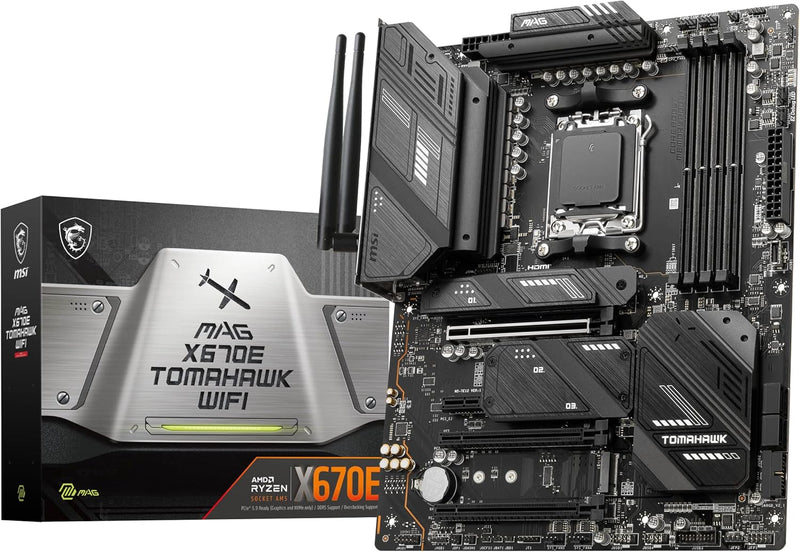
MSI MAG X670E Tomahawk WiFi Gaming Motherboard
PCIe 5.0, DDR5-6600+, and a 14+2+1 power stage make the X670E Tomahawk the enthusiast AM5 foundation that won't bottleneck next-gen storage or GPU bandwidth.
View price on Amazon
Affiliate Disclosure: As an Amazon Associate, Studio Supplies earns from qualifying purchases made through links on this page, at no additional cost to you. This helps support our editorial team.
Notice a mistake? Let Us Know
Overview
Key Features
Support AMD Ryzen 7000 Series Desktop Processors
Supports DDR5 Memory, up to 6600+(OC) MHz
Enhanced Power Design: 14+2+1 Duet Rail Power System, dual 8-pin CPU power connectors, Core Boost, Memory Boost
Lightning Fast Game experience: PCIe 5.0 slot, Lightning Gen5 M.2, USB 3.2 Gen 2x2
Premium Thermal Solution: Extended Heatsink Design and M.2 Shield Frozr are built for high performance system and non-stop works
Specifications
Processor Support
AMD Ryzen 7000 Series Desktop Processors
Memory Type
DDR5 Memory
Memory Speed (OC)
Up to 6600+(OC) MHz
Power Design
14+2+1 Duet Rail Power System
CPU Power Connectors
Dual 8-pin
PCIe Slot
PCIe 5.0
M.2 Support
Lightning Gen5 M.2
USB Connectivity
USB 3.2 Gen 2x2
Cooling
Extended Heatsink Design, M.2 Shield Frozr
Similar Products
Other products from the same family that visitors often consider:
 ✓ Available
MSI MAG X670E Tomahawk WiFi Gaming Motherboard AMD AM5 (Renewed)
$138.44
View on Amazon → ✓ Available
MSI MAG Z790 TOMAHAWK WiFi Gaming Motherboard
View on Amazon → Currently Unavailable
MSI MAG Z590 Tomahawk WiFi Gaming Motherboard
Check on Amazon → ✓ Available
MSI X670E GAMING PLUS WIFI AMD Motherboard
$314.83
View on Amazon → ✓ Available
MSI MAG Z890 TOMAHAWK WIFI Intel Gaming Motherboard
$179.95
View on Amazon →Frequently Asked Questions
Which AMD processors are compatible with this board?
It supports AMD Ryzen 9000, 8000, and 7000 Series desktop processors on the AM5 socket. It does not support AM4 CPUs — the AM5 socket is physically incompatible with previous-generation Ryzen chips.
Does the PCIe 5.0 slot make a real-world difference, or is it future-proofing on paper?
For current GPUs, PCIe 5.0 vs 4.0 bandwidth difference is negligible. The real payoff is on the M.2 side — the Lightning Gen5 M.2 slot enables NVMe SSDs with sequential reads exceeding 10,000 MB/s, which eliminates storage as a bottleneck in large file workflows and fast-loading applications.
What's the maximum RAM this board supports, and at what speed?
Four DDR5 DIMM slots support up to 64GB total. The board is rated for DDR5-6600+ in overclocked mode via XMP/EXPO profiles. Note that high-frequency DDR5 kits may require EXPO-certified memory for stable operation at top speeds.
Does the board include Wi-Fi, and what standard?
Yes — Wi-Fi 6E is built in alongside Bluetooth 5.3. Wi-Fi 6E's 6GHz band support delivers lower latency and higher throughput in congested environments compared to Wi-Fi 6 on the 5GHz band.
Are dual 8-pin CPU power connectors necessary, or can I use one?
One 8-pin connector is sufficient for most Ryzen 9000/7000 builds. The second connector is there for extreme overclocking scenarios where sustained power draw pushes beyond what a single connector can reliably deliver.
Related Products

