



MSI
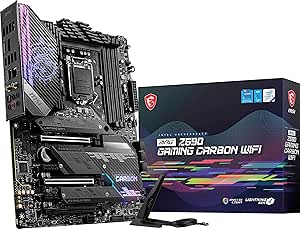
MSI Z590CARBWIFI MPG Z590 Gaming Carbon WiFi Motherboard
7WUSB 3.2
A feature-dense Z590 board with PCIe 4.0, Wi-Fi 6E, and an 18-phase VRM that keeps 11th-gen Intel chips fed under sustained load.
View price on Amazon
Affiliate Disclosure: As an Amazon Associate, Studio Supplies earns from qualifying purchases made through links on this page, at no additional cost to you. This helps support our editorial team.
Notice a mistake? Let Us Know
Overview
Key Features
Supports 11th and 10th Gen Intel Core/Pentium/Celeron processors for LGA 1200 Socket
Supports DDR4 Memory, up to 5333(OC) MHz
Lightning Fast Game experience: PCIe 4.0, Lightning Gen 4 x4 M.2, USB 3.2 Gen 2x2
Enhanced Power Design: 16+1+1 Duet Rail Power System, dual 8-pin CPU power connectors, Core Boost, DDR4 Boost
Premium Thermal Solution: Enlarged heatsink with heat-pipe, MOSFET thermal pads rated for 7W/mk, additional choke thermal pads and 3x M.2 Shield Frozr are built for high performance system and non-stop gaming experience
Specifications
Form Factor
ATX
CPU Socket
LGA 1200
CPU Support
11th/10th Gen Intel Core, Pentium, Celeron
Chipset
Intel Z590
Power Delivery
16+1+1 Duet Rail Power System, Dual 8-pin CPU Power
Memory
4x DDR4 DIMM, up to 5333 MHz (OC)
PCIe Slots
PCIe 4.0 x16 (with 11th-gen CPU), additional PCIe 3.0 slots
M.2 Slots
3x M.2 (1x PCIe 4.0 x4, 2x PCIe 3.0 x4), all with Shield Frozr
USB
USB 3.2 Gen 2x2 (Type-C), USB 3.2 Gen 2, USB 3.2 Gen 1
Networking
2.5G Ethernet, Wi-Fi 6E (Intel AX210), Bluetooth 5.2
Video Output
DisplayPort, HDMI
Lighting
Mystic Light RGB
VRM Cooling
Enlarged heatsink with heat pipe, 7W/mK MOSFET thermal pads
Frequently Asked Questions
Does this motherboard support PCIe 4.0, and what are the conditions?
PCIe 4.0 is supported only with 11th-gen (Rocket Lake) processors. The primary x16 slot and one M.2 slot run at PCIe 4.0 speeds with an 11th-gen CPU installed. With a 10th-gen chip, those interfaces fall back to PCIe 3.0. This is a chipset-level limitation, not a board limitation.
What is the maximum memory speed, and how many DIMM slots are there?
Four DDR4 DIMM slots support up to 5333 MHz with overclocking. The board uses a daisy-chain memory topology with DDR4 Boost trace optimization, which helps push stable XMP profiles. Two DIMMs will typically overclock higher than four.
How many M.2 slots are available, and are they all shielded?
Three M.2 slots, all covered by MSI's M.2 Shield Frozr heatsinks. One slot supports PCIe 4.0 x4 with an 11th-gen CPU. The remaining two run at PCIe 3.0 x4. All three accept 2280 form factor drives.
What Wi-Fi standard does the onboard wireless support?
Wi-Fi 6E via an Intel AX210 module, which adds 6GHz band support on top of standard Wi-Fi 6 (2.4/5GHz). Bluetooth 5.2 is included. The antenna connectors are on the rear I/O panel.
Is the VRM adequate for overclocking an i9-11900K?
The 16+1+1 Duet Rail power system with dual 8-pin EPS connectors is built for exactly that scenario. The enlarged VRM heatsink with integrated heat pipe keeps MOSFET temperatures manageable during sustained all-core loads, and the 7W/mK thermal pads ensure efficient heat transfer from the power stages.
Related Products

