

QNAP
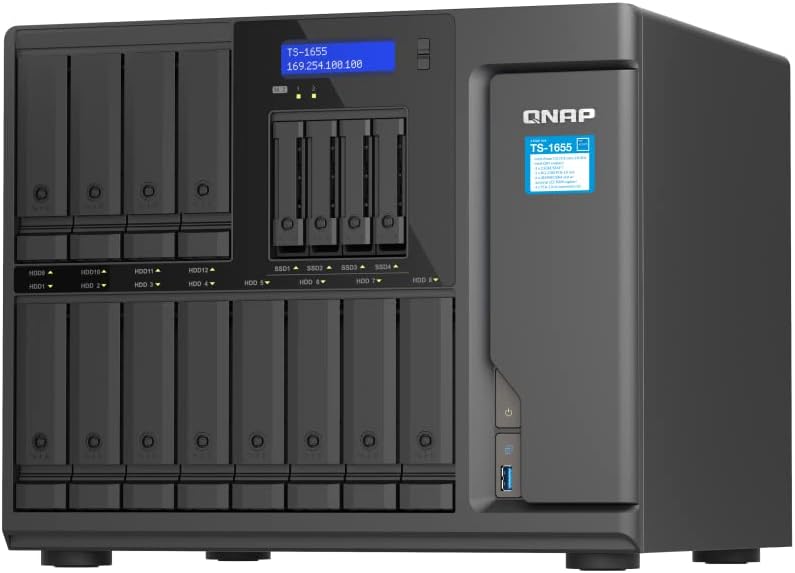
QNAP TS-1655-8G-US 16-Bay Atom 2.5GbE High-Capacity NAS
3.5 InchPCIe Gen 3
A 16-bay hybrid NAS with Intel Atom 8-core power, dual 2.5GbE, and room to grow up to 128GB ECC RAM.
$2,055.78*
Check availability
*Price sourced from Amazon.com. Last updated:Aug 28, 2026.Price and availability are subject to change — details.
Affiliate Disclosure: As an Amazon Associate, Studio Supplies earns from qualifying purchases made through links on this page, at no additional cost to you. This helps support our editorial team.
Notice a mistake? Let Us Know
Overview
Key Features
Intel Atom C-5125 8C processor, burst up to 2.8GHz
8GB UDIMM DDR4 RAM and upgradable to 128GB with ECC support
12 x 3.5 Inch + 4 x 2.5-inch SATA 6Gb/s, 3Gb/s drives
Dual 2.5GbE RJ45 for accelerating intensive file access, large backup/restoration tasks, virtualization, and multimedia transfer
Dual M.2 NVMe PCIe Gen 3 slots allow implementing SSD cache acceleration, SSD storage pool, or a Coral M.2 accelerator for faster image recognition
Specifications
Processor
Intel Atom C-5125, 8-core, burst up to 2.8GHz
Memory
8GB UDIMM DDR4 (upgradable to 128GB, ECC supported)
Drive Bays
12 x 3.5-inch + 4 x 2.5-inch SATA 6Gb/s, 3Gb/s
Network Ports
Dual 2.5GbE RJ45
M.2 Slots
2 x M.2 NVMe PCIe Gen 3
PCIe Slots
3
Brand
QNAP
Model
TS-1655-8G-US
Frequently Asked Questions
How many total drive bays does the TS-1655 have and what sizes do they support?
It has 16 bays total — 12 standard 3.5-inch bays for high-capacity HDDs and 4 dedicated 2.5-inch bays for SSDs, all supporting SATA 6Gb/s and 3Gb/s connections.
Can the 8GB of RAM be upgraded, and does it support ECC memory?
Yes, the TS-1655 supports up to 128GB of UDIMM DDR4 RAM with ECC support, so you can scale memory to match demanding workloads like virtualization or large-scale file serving.
What are the dual M.2 NVMe slots used for?
The two M.2 PCIe Gen 3 slots can be used for SSD caching to speed up frequently accessed data, as an SSD storage pool, or to install a Google Coral M.2 accelerator for AI-powered image recognition within QNAP's apps.
Does this NAS support PCIe expansion cards?
Yes, the TS-1655 includes three PCIe expansion slots, allowing you to add 10GbE network cards, additional storage controllers, or other compatible expansion cards.
What network speeds does the TS-1655 support out of the box?
It ships with dual 2.5GbE RJ45 ports, which can be link-aggregated for increased throughput or failover, and you can add faster networking via the PCIe slots.
Related Products
