



QNAP
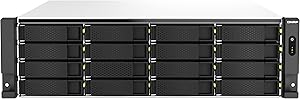
QNAP TS-h2287XU-RP-E2336-32G-US 22-Bay Rackmount ZFS NAS
3.5 InchPCIe Gen 4
A 22-bay ZFS rackmount NAS with Xeon E-2336 muscle and dual 10GbE throughput built to anchor enterprise storage at scale.
View price on Amazon
Affiliate Disclosure: As an Amazon Associate, Studio Supplies earns from qualifying purchases made through links on this page, at no additional cost to you. This helps support our editorial team.
Notice a mistake? Let Us Know
Overview
Maximize Your Business Potential with Advanced Storage Solutions
The QNAP TS-h2287XU-RP-E2336-32G-US is a high-performance 22-bay rackmount hybrid NAS designed for data-intensive enterprise applications. Featuring an Intel Xeon processor, dual 10GbE connectivity, and ZFS storage, this NAS delivers exceptional performance for virtualization, file sharing, and backup/restoration tasks. Its robust features and scalable design make it an ideal solution for growing businesses.
Specifications:
- Processor: Intel Xeon E-2336 6C/12T 2.9GHz (burst up to 4.8GHz)
- Memory: 32GB Long-DIMM DDR4 ECC RAM (upgradable to 128GB)
- Drive Bays: 16 x 3.5 Inch SATA 6Gb/s, 3Gb/s (Front) and 6 x 2.5 Inch SATA (Rear)
- Connectivity: Dual 10GBASE-T port and Dual 2.5GbE RJ45
- Expansion: PCIe Gen 4 slots
Key Features
Intel Xeon E-2336 6C/12T 2.9GHz processor, burst up to 4.8GHz or Intel Xeon E-2378 8C/16T 2.6GHz processor, burst up to 4.8GHz
32GB or 64GB Long-DIMM DDR4 ECC RAM and upgradable to 128GB
16 x 3.5 Inch SATA 6Gb/s, 3Gb/s drives in the Front and 6 x 2. Inch SATA drives
Dual 10GBASE-T port and Dual 2.5GbE RJ45 high-speed connectivity accelerates virtualization, intensive file access, and large backup/restoration tasks
PCIe Gen 4 slots allow for installing additional Network adapters, QM2 cards, or Fibre Channel cards to increase application performance
Optimized collaboration with seamless file sharing and sync
A business-class backup center supporting backup/restore of cloud data and VMs
Create a disaster recovery plan with ransomware protection using QNAP’s storage snapshot solution
Frequently Asked Questions
What does the ZFS file system actually give me over a traditional NAS OS?
ZFS provides end-to-end data integrity via checksumming on every block — meaning silent data corruption (bit rot) is detected and self-healed rather than silently propagated. For a 22-bay array holding tens of terabytes, that's not a luxury, it's insurance.
Can the TS-h2287XU-RP handle simultaneous 10GbE clients without CPU bottleneck?
Yes. The Xeon E-2336's 6 cores / 12 threads at 2.9GHz (burst 4.8GHz) have headroom to serve multiple 10GbE streams concurrently. The dual 10GBASE-T ports offer up to 20Gbps aggregate throughput, and the dual 2.5GbE ports add secondary client lanes without requiring additional cards.
Is the RAM ECC, and why does that matter for a NAS?
Yes — the 32GB (upgradable to 128GB) is Long-DIMM DDR4 ECC. ZFS in particular benefits critically from ECC RAM because it caches write operations in memory before flushing to disk; non-ECC RAM corruption can silently write bad data to your array. ECC is non-negotiable at this tier.
What expansion is possible via the PCIe Gen 4 slots?
The Gen 4 slots support QNAP QM2 cards (adding NVMe caching or M.2 SSDs), additional 25GbE or 100GbE NICs, and Fibre Channel HBAs. This means the NAS can grow into a SAN-adjacent role or accelerate its caching tier without a chassis swap.
How many drives does this unit support in total?
22 bays total — 16 x 3.5-inch SATA front bays for bulk spinning storage and 6 x 2.5-inch SATA rear bays suited for SSDs used as hot-tier or caching drives.
Related Products

