



QNAP
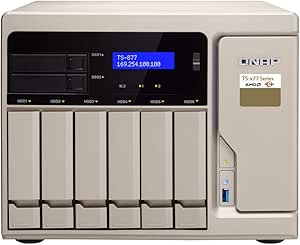
QNAP TS877P Ryzen 7 64GB RAM 24TB HDD NAS Server
3.5 InchRyzen 7 170064GB RAM64GB DDR424TB HDD
An AMD Ryzen 7 eight-core processor, 64GB DDR4, and 26TB of mixed SSD/HDD storage in a desktop mini-tower built for SMB virtualization and iSCSI workloads.
$4,249.00*
View on Amazon
✓ In Stock on Amazon.com
*Price sourced from Amazon.com. Last updated:Aug 28, 2026.Price and availability are subject to change — details.
Affiliate Disclosure: As an Amazon Associate, Studio Supplies earns from qualifying purchases made through links on this page, at no additional cost to you. This helps support our editorial team.
Notice a mistake? Let Us Know
Overview
Key Features
QNAP Turbo NAS TS-877 iSCSI Target NAS Server System for Virtualization in Small Business and Remote Office Environments
Processor: AMD Ryzen 7 1700 8-Core 3.0GHz 4MB CPU, Up to 3.7GHz Turbo; Memory: 64GB DDR4 PC4-19200 2400MHz Unbuffered Memory; SSD Storage: 2TB (2 x 1TB) SATA III Solid State Drives for Ultra Fast Storage; HDD Storage: 24TB (6 x 4TB) 6Gb/s SATA 3.5 Inch HDDs; RAID Levels: JBOD, RAID 0, RAID 1, RAID 10, RAID 5, RAID 6, RAID 50, RAID 60
Operating System: QNAP QTS 4.3; Operating System Features: SSD Caching and Auto-Tiering, Block Based iSCSI LUN Support, HBS 3 Data Deduplication, VJBOD Cloud, Hybrid Mount, QuMagie Auto Media Organization AI, Virtualization Station, Container Station, Hybrid Backup Sync, VM Backup, Snapshots for Volume and LUN, Surveillance Station, IFTTT Agent, QIoT Suite Lite, Mobile NAS Management Apps, and More
QNAP NAS chassis comes in a sealed box
Hard drives and memory upgrades included separately NOT installed, installation required
Specifications
Model
TS-877
Processor
AMD Ryzen 7 1700 8-Core 3.0GHz (Up to 3.7GHz Turbo)
Memory
64GB DDR4 PC4-19200 2400MHz Unbuffered
SSD Storage
2TB (2 x 1TB) SATA III
HDD Storage
24TB (6 x 4TB) 6Gb/s SATA 3.5 Inch
RAID Levels Supported
JBOD, RAID 0, RAID 1, RAID 10, RAID 5, RAID 6, RAID 50, RAID 60
Operating System
QNAP QTS 4.3
Form Factor
NAS Server System
Similar Products
Other products from the same family that visitors often consider:
 ✓ Available
QNAP TS877P NAS - Ryzen 5, 64GB, 2TB SSD, 24TB HDD
$3,799.00
View on Amazon → ✓ Available
QNAP TS877P Ryzen 7 NAS Server SSD HDD Combo
View on Amazon → Currently Unavailable
QNAP TS-464-8G-48ST-US 24TB IronWolf HDD NAS Bundle
Check on Amazon → Currently Unavailable
QNAP ASISP50 Turbo NAS TVS-882 24TB HDD Server i5
Check on Amazon → Currently Unavailable
QNAP TS-1277-1700-64G-US 12-Bay NAS Ryzen 7 64GB 10G-Ready
Check on Amazon →Frequently Asked Questions
What RAID configurations does this NAS support, and which should I use for a small business production environment?
The TS-877 supports JBOD, RAID 0, 1, 10, 5, 6, 50, and 60. For production use where both data protection and usable capacity matter, RAID 6 across the six HDDs provides two-drive fault tolerance while retaining roughly 16TB of usable space from the 24TB raw HDD pool. The two 1TB SSDs are best deployed as an SSD cache layer under QTS to accelerate random read/write operations against the spinning disks.
Is the 64GB RAM sufficient for running virtual machines alongside NAS storage workloads simultaneously?
For most small business use cases — two to four concurrent VMs alongside active NAS access — 64GB DDR4 is adequate. QNAP's Virtualization Station can allocate memory per VM, and the Ryzen 7 1700's eight cores handle concurrent compute without significant contention. Memory-intensive workloads like large database VMs may feel the ceiling faster, but expandability depends on the TS-877's maximum supported RAM.
What network throughput can I realistically expect from the four 1GbE ports?
Each 1GbE port caps at 125MB/s; with all four ports bonded via link aggregation (LACP), theoretical throughput reaches 500MB/s aggregate — though real-world performance to a single client is still limited to one 125MB/s link without a multi-path NIC on the client side. For large sequential transfers from multiple clients simultaneously, bonding delivers measurable improvement.
Does the integrated digital mixer — wait, that's wrong. Does the QTS operating system receive ongoing software updates, and will QTS 4.3 feel outdated quickly?
QTS 4.3 shipped as a capable platform, but QNAP has since released QTS 5.x with enhanced container and virtualization management. The TS-877 hardware is compatible with newer QTS releases, so the bundled version is not the ceiling — check QNAP's firmware portal for current supported versions for this model.
Are the hard drives and memory pre-installed, or does this require assembly before use?
Per the product listing, the hard drives and memory upgrades are included separately and not pre-installed — installation is required. QNAP provides drive bay and RAM installation documentation; the process is straightforward but does require physical setup before the unit is operational.
Related Products
