

Rode
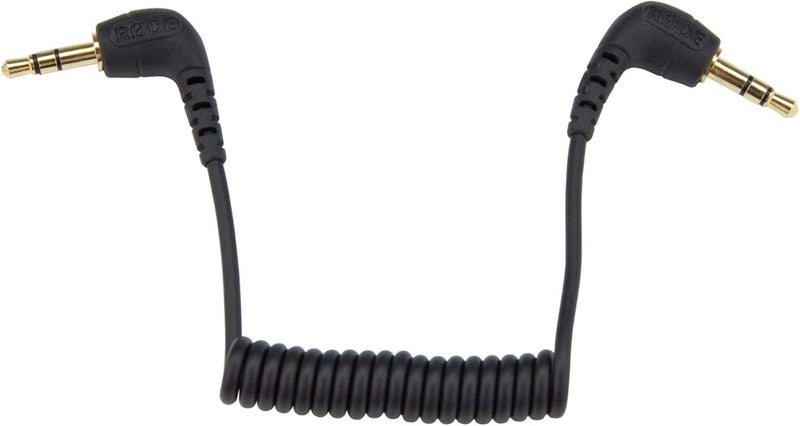
Rode SC2 3.5mm TRS Coiled Patch Cable - Black
A shielded, coiled TRS patch cable that expands from 170mm to 400mm — solving the short-reach problem between tightly packed audio devices without signal degradation.
View price on Amazon
Affiliate Disclosure: As an Amazon Associate, Studio Supplies earns from qualifying purchases made through links on this page, at no additional cost to you. This helps support our editorial team.
Notice a mistake? Let Us Know
Overview
Key Features
**NOT COMPATIBLE WITH MOBILE PHONES.** Mobile phones require a TRRS connection. This is a TRS-to-TRS cable for cameras and audio recorders ONLY. For mobile use, use the RØDE SC4 (TRS-to-TRRS adapter) or SC7 cable.
Connects RØDE microphones with 3.5mm TRS outputs (NTG-series shotguns, VideoMic series, Lavalier II) to DSLR/mirrorless cameras and portable audio recorders.
200mm coiled length — fits neatly in camera rigs without slack.
Locking 3.5mm plugs prevent accidental disconnection during recording.
Compatible RØDE microphones include: NTG2, NTG3, NTG4+, NTG5, VideoMic NTG, VideoMic Pro+, VideoMicro II, Lavalier II, Stereo VideoMic X.
Specifications
Connector Type
3.5mm TRS (Tip-Ring-Sleeve), male-to-male
Cable Type
Coiled, shielded
Rest Length
170mm (coiled)
Extended Length
400mm
Connector Orientation
Right-angle
Audio Channels
Stereo
Color
Black
Compatible Devices
Smartphones, cameras, audio interfaces with 3.5mm TRS inputs/outputs
Frequently Asked Questions
What does the right-angle connector on the SC2 actually solve in a practical setup?
The right-angle plug reduces the mechanical leverage on the 3.5mm jack when the cable exits horizontally from a device — particularly important on recorders, cameras, and interfaces where a straight plug pointing outward creates a strain-failure point if the device is pocketed or mounted. It also saves approximately 25mm of clearance depth behind the connected device.
Is the shielding on the SC2 sufficient to reject interference in environments with wireless transmitters or LED lighting?
The SC2 uses a standard shielded construction designed for typical studio and field recording environments. In high-RF environments — near wireless transmitters operating above 2.4GHz or poorly filtered LED dimmers — no unbalanced 3.5mm TRS cable is inherently immune to interference. The SC2's shielding handles typical interference scenarios, but the unbalanced TRS format is architecturally less rejection-capable than balanced XLR over long runs.
What is the maximum extension length, and does stretching the coil affect signal quality?
The SC2 extends from 170mm (coiled rest length) to 400mm (fully extended). Signal quality over a coiled cable of this length is not measurably affected by extension — the coil geometry does not introduce impedance variation at audio frequencies.
Is this cable compatible with devices that use TRRS connectors (headphone/mic combo jacks)?
No. The SC2 is a TRS (3-pole) cable — tip, ring, sleeve. TRRS jacks (4-pole, used on smartphones for combined headphone/mic) require an adapter or a TRRS-specific cable. Inserting TRS into a TRRS jack will connect audio but the microphone channel will not be addressed.
Can the SC2 carry stereo audio, or is it mono only?
TRS (Tip-Ring-Sleeve) carries stereo — left on tip, right on ring, ground on sleeve. The SC2 is a full stereo patch cable, not a mono TS cable.
Related Products

