SanDisk

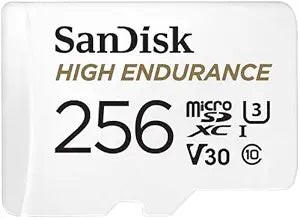
SanDisk High Endurance 256GB MicroSDXC Card SD Adapter

4.6 (112 reviews)
4K

Twenty thousand hours of continuous write endurance in a 256GB microSDXC card that reads at 100 MB/s and is built for never-stop recording applications.

$24.41*
Check availability

*Price sourced from Amazon.com. Last updated:Jun 04, 2026.Price and availability are subject to change.

Affiliate Disclosure: Studio Supplies may earn a commission from qualifying purchases made through links on this page, at no additional cost to you. This helps support our editorial team.

Notice a mistake? Let Us Know

Overview

The SanDisk 256GB High Endurance microSDXC card is purpose-engineered for continuous write applications — not as a marketing claim but as a technical specification: the card is rated to 20,000 hours of recording endurance, validated for the loop-write cycles that destroy standard microSD cards in dash cam, security camera, and body camera deployments. The V30/U3/Class 10 speed ratings guarantee a minimum 30 MB/s sustained write floor, which covers 4K recording at the bitrates used by mainstream consumer and prosumer devices in this application class. Read speeds top at 100 MB/s — fast enough for practical file review and backup transfers when pulling footage for an incident or security audit. At 256GB, the card stores substantial video footage before loop-recording begins overwriting older files.

The use case for this card is narrow and specific — and that specificity is its strength. In any device that records continuously or on motion trigger for extended periods, the write endurance of the storage medium is the binding constraint on system reliability. Standard cards are optimized for burst photography or occasional video — their write cycle ratings are not designed for the grinding, day-after-day overwrite loops that dash cams and outdoor security cameras impose. The High Endurance card's engineering addresses that specific failure mode. The included SD adapter provides a practical path for offloading footage to any standard SD card reader. SanDisk backs the card with a two-year warranty. For the targeted application, it is the technically correct storage choice.

Key Features

Ideal for dash cams and home monitoring systems

Designed for high endurance so you can record for up to 20,000 hours with no worries

Save more videos with capacities up to 256GB

Record in Full HD and 4K with Class 10, U3 and V30 video speed ratings

Quickly transfer or back up videos to computer with read speeds up to 100MB/s

Two-year warranty

Specifications

Capacity
256GB
Card Type
microSDXC UHS-I
Max Read Speed
Up to 100 MB/s
Max Write Speed
Up to 60 MB/s
Speed Class
V30 / U3 / Class 10
Write Endurance
Up to 20,000 hours of recording
Included Accessories
SD adapter
Warranty
2 years

Pros & Cons

👍 Pros

  • The 20,000-hour write endurance rating is specifically validated for continuous loop-recording workloads — a direct measurable advantage over standard cards not rated for sustained write cycles.
  • 256GB capacity provides sufficient storage for extended recording loops before overwriting begins — for a security camera, this can mean days of footage retained rather than hours.
  • The V30 minimum sustained write speed guarantees uninterrupted 4K recording at the bitrates used by mainstream dash cam and home security camera systems.
  • Read speeds of up to 100 MB/s allow rapid file transfers to a computer when reviewing footage, reducing the time spent waiting for large video files to copy.
  • The included SD adapter extends the card's compatibility to any device with a standard SD slot — cameras, computers, and card readers — without requiring a separate adapter purchase.

👎 Cons

  • The 60 MB/s maximum write speed is sufficient for consumer 4K dash cam and security recording but falls short of the V60 or V90 write speeds required by professional cameras shooting high-bitrate RAW video or burst sequences.
  • The UHS-I bus interface imposes a theoretical maximum read bandwidth of approximately 104 MB/s — users with UHS-II card readers will not benefit from the faster bus since this card is UHS-I only.
  • At 256GB, the card provides generous capacity for security cameras, but professional 4K filmmakers who need larger continuous recording buffers may find themselves changing cards more frequently than with 512GB or 1TB options.
  • The SanDisk two-year warranty is shorter than competing endurance-rated cards from other manufacturers that offer three-year coverage on write-intensive microSD products.
  • The card's write endurance is rated under specific recording conditions — unusually high ambient temperatures in vehicle dash cam installations may accelerate wear faster than the rated 20,000 hours in controlled conditions.

Frequently Asked Questions

20,000 hours of continuous write endurance equates to approximately 833 days — more than two years — of non-stop recording. In a real dash cam or security camera that records only when triggered or during operating hours, this card will realistically last several years before write endurance becomes a concern.
The card reads at up to 100 MB/s and writes at up to 60 MB/s. In the context of loop-recording security cameras and dash cams, the write speed is the critical specification — 60 MB/s write capacity handles 4K recording at the bitrates used by most consumer and prosumer dash cam and camera systems without dropped frames.
V30 means the card guarantees a minimum sustained write speed of 30 MB/s — the threshold required for 4K video recording. U3 and Class 10 are equivalent speed class designations in UHS-I and older nomenclature. Together, these ratings confirm the card maintains minimum 4K recording performance consistently under sustained write loads.
Yes — the included full-size SD adapter converts the microSDXC card to standard SD form factor, compatible with any SD card reader including laptop card slots, camera SD slots, and USB SD card readers. This allows direct file access and backup to a computer without a separate microSD reader.
The High Endurance card is engineered and rated specifically for continuous write workloads — dash cams, security cameras, body cameras. For general photography (burst shooting, RAW capture), it is technically compatible but the endurance optimization comes at a write-speed ceiling; dedicated V60 or V90 UHS-II cards offer faster write speeds better suited to high-bitrate burst photography.