



Seagate
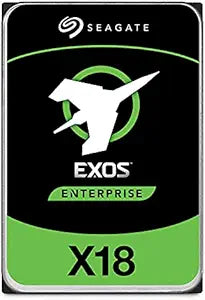
Seagate ST10000NM018G Exos X18 10TB Enterprise HDD
Enterprise-grade 10TB storage with a 2.5M-hour MTBF and 270 MB/s sustained throughput built for always-on data center duty.
$564.37*
View on Amazon
✓ In Stock on Amazon.com
*Price sourced from Amazon.com. Last updated:Oct 23, 2026.Price and availability are subject to change — details.
Affiliate Disclosure: As an Amazon Associate, Studio Supplies earns from qualifying purchases made through links on this page, at no additional cost to you. This helps support our editorial team.
Notice a mistake? Let Us Know
Overview
Key Features
Mean Time Between Failures (MTBF, hours): 2,500,000
Reliability Rating Full 24 x 7 Operation (AFR): 0.35%
Nonrecoverable Read Errors per Bits Read: 1 sector per 10E15
Power-On Hours per Year (24 x 7): 8760
512e Sector Size (Bytes per Sector): 512
Specifications
Capacity
10TB
Interface
SATA 6.0 Gb/s
Spindle Speed
7200 RPM
Cache
256MB
Sector Size
512e / 4KN
MTBF
2,500,000 hours
AFR
0.35%
Max Sustained Transfer Rate (OD)
270 MB/s (read) / 258 MB/s (write)
Random Read 4K QD16
170 IOPS
Random Write 4K QD16
550 IOPS
Average Latency
4.16 ms
Nonrecoverable Read Errors
1 sector per 10E15 bits read
Power-On Hours Rated
8,760 hrs/year (24x7)
Warranty
5 years
Similar Products
Other products from the same family that visitors often consider:
 ✓ Available
Seagate ST10000NM018G Exos X18 10TB SATA HDD
$573.00
View on Amazon → ✓ Available
Seagate ST10000NM013G Exos X18 10TB Enterprise HDD
$684.75
View on Amazon → ✓ Available
Seagate ST10000NM017B Exos 7E10 10TB Enterprise HDD
$644.45
View on Amazon → ✓ Available
Seagate ST12000NM002G Exos X18 16TB Enterprise HDD
$692.29
View on Amazon → ✓ Available
Seagate ST18000NM000J Exos X18 18TB Enterprise HDD
$204.99
View on Amazon →Frequently Asked Questions
What interface does the Exos X18 10TB use, and what host systems does it support?
This model uses a SATA 6.0 Gb/s interface, which is compatible with any standard SATA II or SATA III host controller — servers, NAS enclosures, JBOD arrays, and desktop workstations. It also ships in SAS variants; confirm you're purchasing the SATA model if your backplane doesn't support SAS.
What does the 0.35% AFR rating mean in practice?
AFR (Annualized Failure Rate) of 0.35% means Seagate projects fewer than 4 failures per 1,000 drives per year under continuous 24/7 operation. In a 10-drive array, statistically you'd expect roughly one drive failure every 28+ years — meaningfully better than desktop-class drives with AFRs of 1–2%, and it's why this drive carries a 5-year warranty.
How does the 256MB cache affect workload performance?
The 256MB cache buffers sequential read/write bursts, which is particularly beneficial for streaming large files — video archives, database dumps, backup writes. For random 4K I/O (170 read / 550 write IOPS at QD16), the cache helps smooth queue spikes, though an SSD cache tier in your NAS or server will make a more significant difference for mixed random workloads.
Is the 512e sector format compatible with modern operating systems and RAID controllers?
Yes — 512e (512-byte emulated sectors with 4K physical sectors) is broadly compatible with Windows Server, Linux, VMware ESXi, and most RAID controllers that might reject native 4Kn drives. Some older controllers or NAS firmware versions may require a firmware update to fully support it; verify your specific hardware's compatibility list before deployment.
What is the power consumption of the Exos X18 10TB, and is it suitable for NAS enclosures with tight power budgets?
Seagate rates the Exos X18 for enterprise duty at higher power draw than NAS-optimized drives like the IronWolf Pro. In multi-drive NAS enclosures, the cumulative power and heat output of several Exos drives can stress power supplies and cooling systems sized for consumer NAS drives. Verify your enclosure's rated power delivery before populating it with Exos drives.
Related Products
