



Seagate
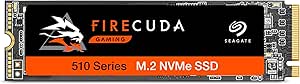
Seagate FireCuda 510 250GB NVMe Gen3 SSD
250GB NVMe
PCIe Gen3 NVMe speeds up to 3200MB/s in a compact M.2 2280 form factor — the FireCuda 510 closes the bottleneck between your CPU and storage.
$42.26*$68.99Save 38%
Check availability
*Price sourced from Amazon.com. Last updated:Aug 30, 2026.Price and availability are subject to change — details.
Affiliate Disclosure: As an Amazon Associate, Studio Supplies earns from qualifying purchases made through links on this page, at no additional cost to you. This helps support our editorial team.
Notice a mistake? Let Us Know
Overview
Key Features
Meet the high-speed SSD for pro-level PC gamers and creative pros—delivering up to 3200/1300MB/s sequential read/write speeds and 250GB of massive capacity
High IOPS ensure consistently smooth streaming, high-speed PC game downloads, and seamless application usage
Ultra-slim M.2 2280 form factor is designed to handle the sustained abuse of top-tier gaming PCs and gaming laptops
Enjoy long-term reliability with 1.8M hours MTBF
The available storage capacity may vary.
Specifications
Capacity
250GB
Form Factor
M.2 2280
Interface
PCIe Gen3 x4, NVMe 1.3
Sequential Read Speed
Up to 3200MB/s
Sequential Write Speed
Up to 1300MB/s
MTBF
1.8 million hours
Model
ZP250GM3A001
Frequently Asked Questions
What interface and slot does the FireCuda 510 250GB require, and will it work in a PCIe Gen4 slot?
The FireCuda 510 uses a PCIe Gen3 x4 NVMe 1.3 interface in an M.2 2280 form factor. It is backward and forward compatible with PCIe Gen4 M.2 slots — the drive will operate at Gen3 speeds in a Gen4 slot, which is still its rated 3200/1300MB/s. Confirm your motherboard or laptop has an M.2 slot with NVMe support, as SATA-only M.2 slots will not recognize this drive.
At 250GB, how much usable space will I actually have after formatting?
After the manufacturer's binary-to-decimal capacity conversion and OS formatting overhead, expect approximately 232GB of usable space in Windows. The 250GB figure is a decimal (1GB = 1,000,000,000 bytes) measurement — operating systems report in binary (1GB = 1,073,741,824 bytes), which accounts for the difference.
Does the FireCuda 510 require a heatsink, and will it throttle under sustained workloads?
The FireCuda 510 does not include a heatsink. Under sustained sequential writes — large file transfers, video editing scratch disk use — the drive can experience thermal throttling without adequate airflow or a motherboard heatsink cover. For gaming and light creative use, stock airflow in most mid-tower cases is sufficient. For sustained professional workloads, a third-party M.2 heatsink is recommended.
What is the rated endurance and warranty for this drive?
The FireCuda 510 250GB is rated at 1.8 million hours MTBF. Seagate provides a 5-year limited warranty, which is competitive at this tier and reflects confidence in long-term reliability. TBW (terabytes written) endurance data for this specific SKU should be verified in Seagate's current product documentation.
Is this drive suitable as a boot drive for a creative workstation or gaming PC?
Yes. The 3200MB/s sequential read speed makes OS boot times and application load times substantially faster than SATA SSDs (typically capped at 560MB/s). For a 250GB capacity, it works best as a dedicated OS and applications drive, with a secondary drive handling large media assets or game libraries.
Related Products
