
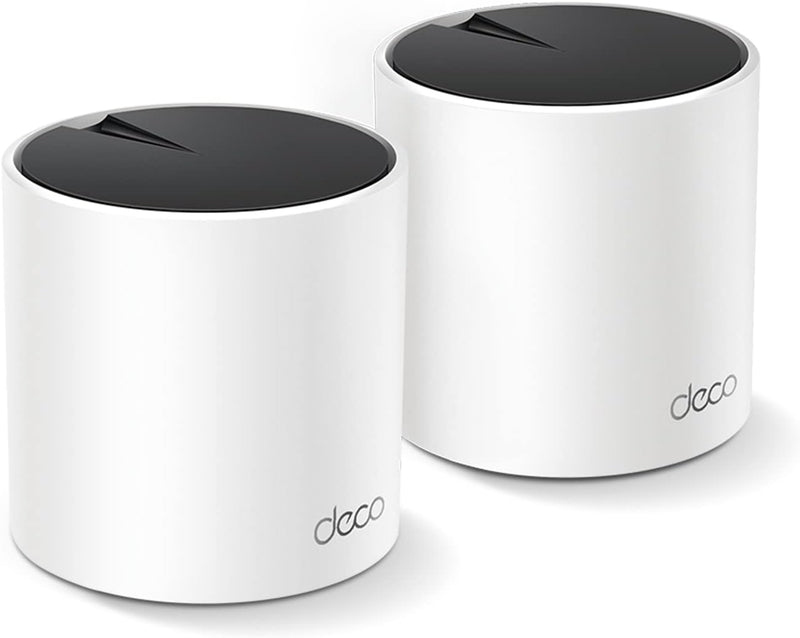


TP-Link Deco X55 (2-Pack) — Sizing, Device Capacity, and Network Compatibility
The 2-pack configuration of the Deco X55 is positioned for apartments and smaller homes — up to 4,500 sq ft per TP-Link's product specifications, versus 6,500 sq ft for the 3-pack of the same hardware. Same units, same AX3000 spec — the difference is mesh density across the covered area.
When 2 Units Is the Right Choice
| Home Profile | 2-Pack Fits | Consider 3-Pack Instead If... |
|---|---|---|
| Apartment / condo, single floor | Yes — up to 2,500-3,500 sq ft | Thick interior walls or unusual layout creates dead zones |
| Townhouse, 2 floors | Yes — one unit per floor | Basement plus 2 above-ground floors |
| Small single-family home, 1-2 floors | Yes — up to ~3,500 sq ft total | Detached garage, basement, or outdoor coverage required |
| Mid-size 2-story home | Borderline — 2 units may have weak spots | Stair geometry forces signal through multiple solid walls |
| 3+ story home or large footprint | No — go with 3-pack | Always; backhaul-to-Ethernet recommended |
Real Coverage Per Unit
Each Deco X55 unit covers approximately 2,000-2,500 sq ft of clear-line-of-sight area with single-wall-thickness penetration. In practice:
- Drywall + studs — single-wall signal loss of ~3-5 dB; minimal impact
- Cinder block / concrete walls — 10-20 dB signal loss per wall; meaningfully reduces effective range
- Steel framing / metal HVAC ductwork — can reflect signal in ways that create dead zones not predictable from floor plan alone
- Floor penetration — wood-frame floors are minimal loss; concrete-slab floors are significant loss
Device Capacity
Per TP-Link's product specifications, each Deco X55 unit supports approximately 150 concurrent device connections — total 300 across the 2-pack. Real-world smart-home density rarely approaches this even at the high end (a typical smart home is 30-60 connected devices; a heavy IoT deployment with sensors and cameras can reach 80-120). Per-unit device-handling capability is rarely the bottleneck for residential deployments.
Ethernet Backhaul Support
The Deco X55 supports wired Ethernet backhaul between mesh units when the home has structured cabling available. Per Dong Knows Tech's coverage of the Deco X55 family, backhaul over Ethernet substantially improves both throughput and latency between mesh nodes compared to wireless backhaul. If the home has any of these wiring options:
- Existing Cat5e / Cat6 between rooms
- MoCA adapters using existing coaxial wiring
- Powerline adapters (with the usual caveats around panel routing)
...wiring at least the primary mesh hop is the single largest performance improvement available, especially for the 2-pack configuration where there's only one mesh hop to optimize.
What This Pack Is NOT For
- Multi-gig WAN connections — each Deco X55 unit has gigabit Ethernet WAN. Buyers with 1.5 Gbps or faster internet should look at the Deco X55 Pro (2.5 Gbps WAN) or a higher-tier mesh family
- Heavy WiFi 6E / WiFi 7 use cases — the X55 is WiFi 6 (AX), not WiFi 6E or WiFi 7. Recent flagship phones, laptops, and consoles support WiFi 6E with 6 GHz spectrum that the X55 cannot access
- Detached garage or outdoor area coverage — even the 3-pack struggles to reach outdoor spaces through exterior walls. Outdoor coverage needs a dedicated outdoor access point, not additional mesh units
- Networks with VLAN, advanced QoS, or pro-grade segmentation requirements — the Deco family is consumer-tier; pro-tier needs Unifi, pfSense, or similar prosumer hardware
Smart Home Compatibility Notes
- HomeKit / Matter — the Deco X55 supports HomeKit per TP-Link's product specs, allowing Apple Home users to integrate the router into the Home app
- Most smart-home protocols (Zigbee, Z-Wave, Thread) are NOT carried over WiFi and don't depend on the router; the X55 is irrelevant to those protocols
- WiFi-based smart home devices (smart bulbs, smart plugs, cameras) generally connect to 2.4 GHz; the X55's dual-band coverage handles them cleanly
Sources & Citations
- TP-Link, "Deco X55 product family page," tp-link.com (accessed 2026-05-16)
- Dong Knows Tech, "TP-Link Deco X55 Pro Review," dongknows.com (accessed 2026-05-16)
- Wi-Fi Alliance, "WiFi 6 (802.11ax) overview," wi-fi.org (accessed 2026-05-16)
Last verified: 2026-05-16


