
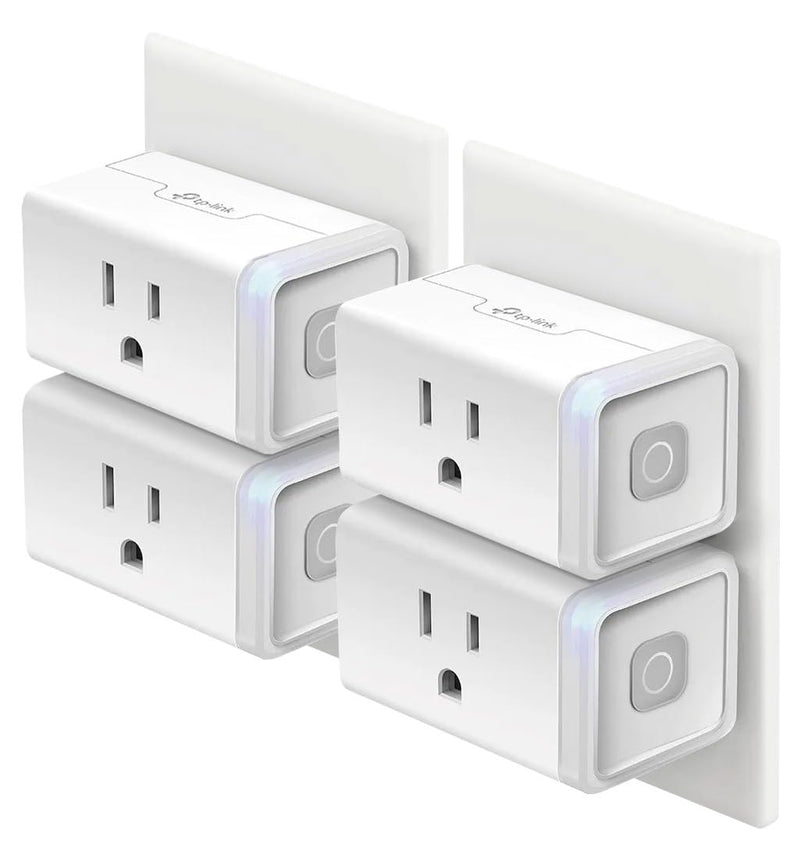


TP-Link Kasa Smart Plug Mini 4-Pack (HS103P4) — Editorial Review & Use Cases
The TP-Link Kasa Smart Plug Mini (HS103P4 4-pack, plus single HS103 and 2-pack HS103P2 variants) is TP-Link's compact 2.4GHz WiFi-controlled smart plug — slim profile that doesn't block the second outlet on a duplex wall receptacle, controlled via Kasa Smart mobile app, Amazon Alexa, Google Assistant, and Samsung SmartThings. Per TP-Link's official Kasa HS103 product page, the smart plug supports up to 15A (1875W) loads, away-mode randomized scheduling, voice control, schedule + timer + countdown, and remote on/off from anywhere with internet via the Kasa cloud service.
What the Kasa Smart Plug Mini Specifically Wins
- Slim mini-profile design — doesn't block the second outlet on a standard duplex receptacle. Two HS103s can stack on a single dual outlet
- WiFi-only — no hub required — plugs into 2.4GHz home WiFi directly. No Hubitat / SmartThings / Hue hub investment needed (vs Z-Wave / Zigbee smart plugs)
- Triple voice assistant compatibility — Amazon Alexa, Google Assistant, Samsung SmartThings native integration
- Kasa Smart mobile app (iOS / Android) — scheduling, timers, away-mode random scheduling, energy monitoring (on energy-monitor variants), grouping, scenes
- 15A load capacity — supports most household appliances including space heaters, AC window units (under 15A), holiday lighting, fans, lamps
- Away mode — randomizes on/off times during travel to simulate occupancy (security benefit)
- 4-pack pricing efficiency — multi-pack discount vs buying 4 individual smart plugs
- No subscription fees — Kasa Smart cloud service is free; voice control works permanently
- UL listed — independent safety verification
- Reset button on device — physical reset for re-pairing if WiFi changes
- IFTTT integration for automation across other smart home services
Where the Kasa Smart Plug Specifically Fits
- Smart-home starter setup — first-time smart plug deployment
- Christmas / holiday lighting automation — sunset-to-bedtime auto-on
- Lamp / floor lamp scheduling — dawn-to-evening simulation
- Coffee maker auto-start in morning (via schedule)
- Space heater / fan remote on/off when away from home
- Away-mode security simulation during travel
- Apartment / dorm / rental smart-home (no hub)
- Voice-controlled gadget on/off — "Alexa, turn on the desk lamp"
- Multi-device 4-pack — covers bedroom + living room + kitchen + office
- Smart-home upgrade for older home without rewiring
- Energy monitoring on Energy variants (HS300 family) — verify cost-per-appliance
- 3D printer / shop tool remote shutdown after long runs
- Pet feeder / aquarium pump scheduling
- Server / homelab UPS smart power management
Honest Limits Buyers Should Know
- 2.4GHz WiFi only — no 5GHz support. Must connect to 2.4GHz band of dual-band routers. Some modern mesh routers default to 5GHz-only — verify 2.4GHz availability before purchase
- WiFi-dependent. Internet outage = no remote control. Local control via Kasa app on home network still works during ISP outages, but cloud-based commands (Alexa from a remote location, Google Home routines) fail
- TP-Link cloud dependency. Discontinuation of Kasa cloud (unlikely but possible) would break remote control. TP-Link's track record: strong; Kasa has been operational 10+ years
- 15A max — heavy loads (microwave + AC + dryer) NOT supported. 1800W is fine for fans, lamps, holiday lights; not for hair dryers, space heaters above 1500W, or major appliances
- No Apple HomeKit support. Kasa supports Alexa / Google / SmartThings but NOT HomeKit. iPhone-primary households with HomeKit setups need different smart plugs (Eve Energy, Aqara T1, Wemo Mini)
- Privacy considerations. Kasa cloud receives device on/off events + schedules. For zero-cloud smart home, use local-only solutions (Home Assistant + Z-Wave/Zigbee plugs)
- Standby power consumption. Smart plugs draw ~0.5W idle even when device is off. Across 10+ smart plugs in a home, this is ~5W constant + ~$5/year electricity. Negligible but real
- App-based reset can be tedious if WiFi changes. Router replacement requires re-pairing all smart plugs via Kasa app
- No built-in energy monitoring on HS103. For energy monitoring, step up to HS300 (Energy Monitoring) or Kasa Smart Plug Mini with energy monitoring
- UL listed but not Matter / Thread protocol. The newer Matter standard (2023+) is the future of smart home interop; HS103 predates Matter. Future smart plug investments may benefit from Matter-compatible options
- Outlet on/off only — no dimming. For dimmable lamps, use Kasa Smart Dimmer Switch or Lutron Caseta
Where Buyers Should Look Elsewhere
- Apple HomeKit support → Eve Energy, Aqara T1 Smart Plug, Meross MSS210H (HomeKit-compatible)
- Matter / Thread smart home standard → newer Matter-compatible plugs (Wemo Smart Plug Matter, Aqara T1 Matter variant)
- Energy monitoring → Kasa HS300 (6-outlet with energy monitoring), Sense Energy Monitor (whole-home)
- Local-only / no cloud → Home Assistant + Z-Wave or Zigbee smart plugs (Aeotec Smart Switch 7, Sonoff with Tasmota firmware)
- Outdoor / weatherproof → TP-Link Kasa Smart Outdoor Plug (KP400, IP65-rated)
- High-draw appliances (>15A) → hardwired smart switches via electrician install
- Dimmable lighting → Kasa Smart Dimmer Switch, Lutron Caseta dimmer + Pico remote
- Premium / aesthetic → Apple HomePod Mini + HomeKit accessory bundle
- Single-plug deployment → HS103 (single) instead of 4-pack
Sources & Citations
- TP-Link, "Kasa Smart Plug HS103 product page," tp-link.com (accessed 2026-05-19)
- The Verge, "TP-Link Kasa Smart Plug review and smart home buying guide," theverge.com (accessed 2026-05-19)
- Tom's Guide, "Best smart plugs buying guide," tomsguide.com (accessed 2026-05-19)
- The Wirecutter (NYT), "Best smart plug buying guide," nytimes.com/wirecutter (accessed 2026-05-19)
Last verified: 2026-05-19


