

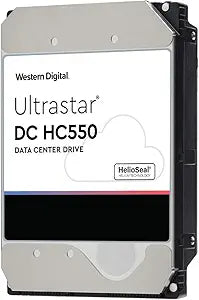


Western Digital
Western Digital 0F38462 16TB SATA Ultra SE HDD
16TB of SATA enterprise capacity with a 512MB cache buffer engineered to sustain sequential throughput under continuous NAS and data center workloads.
$649.45*
View on Amazon
✓ In Stock on Amazon.com
*Price sourced from Amazon.com. Last updated:Oct 21, 2026.Price and availability are subject to change — details.
Affiliate Disclosure: As an Amazon Associate, Studio Supplies earns from qualifying purchases made through links on this page, at no additional cost to you. This helps support our editorial team.
Notice a mistake? Let Us Know
Overview
Key Features
0F38462
Specifications
Capacity
16TB
Interface
SATA III (6Gb/s)
Cache
512MB
Form Factor
3.5"
Recording Technology
CMR (Conventional Magnetic Recording)
Enclosure
HelioSeal (hermetic helium-filled)
Model
WD DC HC550 (0F38462)
Intended Use
Enterprise / Data Center / NAS
Similar Products
Other products from the same family that visitors often consider:
 ✓ Available
Western Digital DC HC550 16TB SATA Enterprise HDD
$499.99
View on Amazon → ✓ Available
Western Digital WUH721816ALE6L4 16TB 7.2K SATA HDD
$784.45
View on Amazon → ✓ Available
Western Digital WD161KRYZ 16TB Gold Enterprise HDD - 7200RPM SATA
$749.99
View on Amazon → ✓ Available
Western Digital WD161KFGX-SPAFPN0 16TB Red Pro NAS HDD
$714.99
View on Amazon → ✓ Available
Western Digital WUH721816ALE6L4 16TB Ultrastar Enterprise HDD Renewed
$499.99
View on Amazon →Frequently Asked Questions
What is the WD DC HC550, and how does it differ from WD's consumer drives?
The DC HC550 is Western Digital's enterprise-class CMR (Conventional Magnetic Recording) hard drive, built for 24/7 operation in demanding environments. Unlike WD's consumer Blue or Red lines, the HC550 is rated for higher annual workload requirements (typically 550TB/year) and uses HelioSeal technology — a hermetically sealed helium-filled enclosure that reduces internal turbulence, enabling higher platter density and lower operating temperatures than air-filled drives.
Will this drive work in a consumer NAS (Synology, QNAP, etc.)?
Physically yes — it uses a standard SATA interface and 3.5" form factor. However, the HC550 is an enterprise-class drive not specifically validated against consumer NAS compatibility lists in the way that WD Red Pro or Seagate IronWolf are. Check your NAS vendor's compatibility matrix before deploying. It will function but may not carry the explicit NAS-vendor support that purpose-branded NAS drives do.
What does the 512MB cache buffer mean for real-world performance?
At 512MB, this is one of the larger cache buffers available in a SATA HDD. It primarily benefits sequential read/write bursts — large file transfers, backup jobs, and streaming workloads will see the cache absorb bursts more effectively before the drive must rely on sustained platter throughput. For random small-file access (typical of OS boot drives), the spinning-disk architecture is still the fundamental constraint, not the cache.
Is CMR recording technology important here?
Yes, particularly for RAID environments. CMR (vs. SMR, Shingled Magnetic Recording) writes data in non-overlapping tracks, which means RAID rebuild operations, parity writes, and simultaneous read/write workloads perform predictably. SMR drives can exhibit significant performance degradation during RAID rebuilds — a risk you don't take on with this CMR-based enterprise drive.
What interface does this drive use and what transfer speeds should I expect?
SATA III (6Gb/s). While the bus supports up to 600MB/s, the mechanical platter is the actual throughput ceiling. Western Digital's enterprise 7200RPM SATA drives in this capacity class typically sustain 200–270MB/s sequential read, which is the expected operating range for the HC550.
Related Products
