



Western Digital
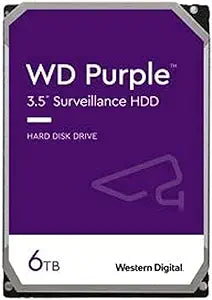
Western Digital WD Purple 6TB Surveillance HDD Renewed
6TB of AllFrame-optimized surveillance storage on a factory-renewed 3.5" SATA drive built to sustain 180 TB/yr write workloads across 24/7 security system operation.
View price on Amazon
Affiliate Disclosure: As an Amazon Associate, Studio Supplies earns from qualifying purchases made through links on this page, at no additional cost to you. This helps support our editorial team.
Notice a mistake? Let Us Know
Overview
Specifications
Series
WD Purple
Capacity
6TB
Drive Type
Surveillance HDD
Condition
Renewed
Similar Products
Other products from the same family that visitors often consider:
 ✓ Available
Western Digital WD Black 6TB Renewed Performance HDD
$310.00
View on Amazon → ✓ Available
Western Digital WD60EZAZ-cr 6TB WD Blue HDD (Renewed)
View on Amazon → ✓ Available
Western Digital WD60EZAX-SPC8VB0 6TB WD Blue HDD
$244.99
View on Amazon → ✓ Available
Western Digital WD Purple Surveillance 3TB Renewed HDD
$200.00
View on Amazon → ✓ Available
Western Digital WD62PURZ 6TB Purple Surveillance HDD
View on Amazon →Frequently Asked Questions
What does AllFrame technology on the WD Purple specifically optimize, and how does it differ from a standard desktop drive in a surveillance role?
AllFrame is WD's firmware-level optimization for ATA streaming commands — it enables the drive to handle the continuous sequential write workload of surveillance video without triggering error recovery routines that would cause dropped frames. Standard desktop drives are optimized for random I/O and will invoke error recovery time control (ERC/TLER) procedures that can stall for seconds during a write error, causing camera recording interruptions. The WD Purple's firmware specifically avoids this, prioritizing frame continuity over aggressive error correction.
What is the 180 TB/yr workload rating for the WD Purple 6TB, and how many simultaneous camera streams does that support?
180 TB/yr translates to approximately 494 GB per day of sustained writes. For reference, a 1080p H.265 security camera stream at moderate bitrate (approximately 1–2 Mbps) records roughly 10–25 GB per day. At 180 TB/yr, the WD Purple 6TB can handle 15–40 simultaneous 1080p camera streams, depending on bitrate, without exceeding its rated workload envelope. Exceeding 180 TB/yr accelerates wear beyond the drive's rated service life.
Does the "factory renewed / recertified" status with zero power-on hours mean this drive is equivalent to a new drive?
Zero power-on hours confirmed by the seller means the drive's firmware counters show no runtime — the drive has been data-wiped and certified to show no prior operation hours. WD factory renewed drives undergo WD's own recertification process, which includes testing, firmware reset, and quality verification. It is not the same as a brand-new drive with an unbroken manufacturing chain, but WD's recertification process is among the most rigorous in the industry, and factory-renewed WD drives consistently perform to spec in deployment.
Is the WD Purple 6TB compatible with standard desktop PC motherboards, or does it require a specific surveillance NVR interface?
The WD Purple 6TB uses a standard SATA 6 Gb/s interface — it connects to any motherboard or NVR with a standard SATA port. No special controller or cabling is required. The drive is also compatible with RAID arrays, though WD's AllFrame firmware is optimized for direct-attached surveillance use; RAID compatibility is supported but the drive's primary optimization is for DVR/NVR write patterns rather than RAID striping or mirroring workloads.
How does the 256MB cache on the WD Purple 6TB affect surveillance recording performance versus a drive with a smaller cache?
The 256MB DRAM cache is large for a surveillance-class drive and provides two advantages: buffering write bursts from multiple simultaneous camera streams before committing to platters, and enabling the drive's firmware to organize write sequences for more efficient platter access. For DVR/NVR systems recording many channels simultaneously, the cache absorbs short-term write spikes without forcing the recording system to wait for platter latency, which translates to fewer dropped frames during high-activity recording periods.
Related Products
