



Price history
Acer
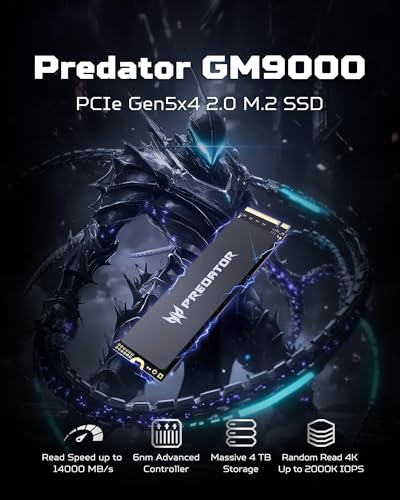
Acer Predator GM9000 PCIe Gen5 NVMe M.2 Internal SSD
A PCIe 5.0 powerhouse pushing up to 14,000 MB/s reads with a spacious 4TB capacity for creators, gamers, and AI workloads
$749.99*
View on Amazon
✓ In Stock on Amazon.com
*Price sourced from Amazon.com. Last updated:Aug 05, 2026.Price and availability are subject to change.
Affiliate Disclosure: Studio Supplies may earn a commission from qualifying purchases made through links on this page, at no additional cost to you. This helps support our editorial team.
Notice a mistake? Let Us Know
Overview
Key Features
Upgraded Performance: PCIe 5.0 SSD has performance doubled compared to PCIe 4.0. It delivers blazing-fast speed, a maximum read speed of 14000 MB/s and a maximum write speed of 13000 MB/s.
Specifications
Brand
Acer Predator
Model
GM9000
Manufacturer
BIWIN
Capacity
4TB
Interface
PCIe Gen5x4 NVMe
Form Factor
M.2
Max Read Speed
Up to 14,000 MB/s
Max Write Speed
Up to 13,000 MB/s
Cache
SLC + DRAM Cache
Compatibility
Desktops and laptops with PCIe 5.0
Frequently Asked Questions
How much faster is the Predator GM9000 than a PCIe 4.0 SSD?
Acer states the Gen5 GM9000 doubles the performance of PCIe 4.0 drives, with reads up to 14,000 MB/s and writes up to 13,000 MB/s versus the roughly 7,000 MB/s ceiling of the prior generation.
What capacity does this Predator GM9000 listing offer?
This listing is the 4TB model, giving substantial room for large game libraries, high-resolution video projects, and AI datasets on a single M.2 drive.
Do I need a special motherboard to reach the GM9000's top speeds?
Yes. To approach the rated 14,000 MB/s, your system needs a native PCIe 5.0 M.2 slot; on older PCIe 4.0 boards the drive will run but at reduced Gen4 speeds.
What does the SLC plus DRAM cache on the GM9000 do?
The combined cache design is meant to sustain responsiveness during longer, heavier transfers, helping the drive maintain quick performance beyond short bursts of activity.
Will the Predator GM9000 work in a laptop?
Acer lists it as compatible with desktops and laptops, though it requires a system with an M.2 slot supporting the PCIe 5.0 interface to deliver its full Gen5 performance.
Related Products


