



Corsair
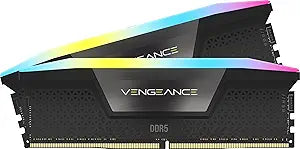
Corsair CMH32GX5M2B6000C40 Vengeance RGB DDR5 32GB
Corsair Vengeance RGB DDR5-6000 CL40 pushes 32GB of dual-channel bandwidth with ten-zone addressable lighting and onboard voltage regulation for stable overclocking on Intel DDR5 platforms.
$629.00*
View on Amazon
✓ In Stock on Amazon.com
*Price sourced from Amazon.com. Last updated:Oct 24, 2026.Price and availability are subject to change — details.
Affiliate Disclosure: As an Amazon Associate, Studio Supplies earns from qualifying purchases made through links on this page, at no additional cost to you. This helps support our editorial team.
Notice a mistake? Let Us Know
Overview
Key Features
Dynamic Ten-Zone RGB Lighting: Illuminate your system with ten individually addressable, ultra-bright RGB LEDs per module, encased in a panoramic light bar for vivid RGB lighting from any viewing angle.
Onboard Voltage Regulation: Enables easier, more finely-tuned, and more stable overclocking through CORSAIR iCUE software than previous generation motherboard control.
Custom Intel XMP 3.0 Profiles: Customize and save your own XMP profiles via iCUE to tailor performance by app or task for greater efficiency.
Create and Customize: Choose from dozens of preset lighting profiles, or create your own in iCUE.
Maximum Bandwidth and Tight Response Times: Optimized for peak performance on the latest Intel DDR5 motherboards.
Specifications
Memory Type
DDR5
Capacity
32GB (2 x 16GB)
Speed
6000MHz
CAS Latency
CL40
RGB Zones
10 individually addressable LEDs per module
Profile
Intel XMP 3.0
Voltage Regulation
Onboard PMIC
Software
CORSAIR iCUE compatible
Similar Products
Other products from the same family that visitors often consider:
 Currently Unavailable
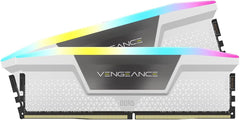
Corsair Vengeance RGB DDR5 32GB 6000MHz RAM
Check on Amazon → Currently Unavailable
Corsair CMH32GX5M2B6400C32 Vengeance RGB DDR5 32GB RAM
Check on Amazon → Currently Unavailable
Corsair CMH32GX5M2E6000C36W VENGEANCE RGB DDR5 32GB
Check on Amazon → Currently Unavailable
Corsair CMH32GX5M2B5600C40K Vengeance RGB DDR5 32GB
Check on Amazon →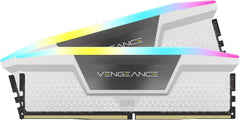 Currently Unavailable
Corsair VENGEANCE RGB 32GB DDR5 6000MHz White Desktop Memory
Check on Amazon →Frequently Asked Questions
What motherboard and CPU platforms is the CMH32GX5M2B6000C40 optimized for?
This kit is designed for Intel DDR5 platforms using XMP 3.0 — specifically Intel 12th Gen (Alder Lake) and 13th Gen (Raptor Lake) motherboards with DDR5 support. AMD Expo profiles are not included, so performance on AMD AM5 platforms will depend on board-level DDR5 compatibility and manual tuning rather than plug-and-play profile activation.
What does CL40 latency mean at 6000MHz, and is it a performance trade-off worth making?
CL40 at 6000MHz translates to an absolute latency (tCL/2 × 1/frequency) of approximately 13.3 nanoseconds — competitive for DDR5 at this speed tier. The 6000MHz frequency provides substantial bandwidth gains over baseline DDR5-4800, and at this latency the real-world gaming and application performance delta over tighter-latency kits (CL36 at 6000MHz) is measurable in benchmarks but small in practice.
Does the Vengeance RGB require CORSAIR iCUE software to function at rated speeds?
No. The XMP 3.0 profile activates at 6000MHz through BIOS — no software installation required for performance. CORSAIR iCUE is required only for advanced RGB control (ten-zone per-module customization, lighting sync with other iCUE devices) and for creating custom XMP 3.0 profiles via the onboard voltage regulation feature.
What does onboard voltage regulation on the Vengeance RGB DDR5 actually do versus motherboard-controlled voltage?
DDR5 modules include an integrated Power Management IC (PMIC) that handles on-die voltage regulation. Corsair's implementation allows finer voltage tuning through iCUE software at the module level, rather than relying solely on the motherboard's VDD/VDDQ voltage settings. In practice, this enables more stable overclocking at specific voltage steps that the motherboard's coarser adjustment increments might skip.
What happens to the RGB lighting if iCUE is not installed?
Without iCUE, the modules default to a hardware-controlled RGB cycling pattern. The LEDs remain active and visible, but per-zone color assignments, static color modes, and synchronization with other iCUE devices are unavailable. For users who simply want the visual effect without software overhead, the default cycling pattern is functional.
Related Products
