



Crucial
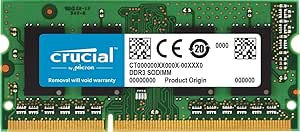
Crucial CT51264BF186DJ 4GB DDR3L 1866MHz SODIMM Memory
A 4GB DDR3L SODIMM running at 1866 MT/s gives aging notebooks a measurable responsiveness boost — one of the fastest standard SODIMM speeds available for compatible ultrabooks and thin-and-light systems.
$26.29*
View on Amazon
✓ In Stock on Amazon.com
*Price sourced from Amazon.com. Last updated:Oct 21, 2026.Price and availability are subject to change — details.
Affiliate Disclosure: As an Amazon Associate, Studio Supplies earns from qualifying purchases made through links on this page, at no additional cost to you. This helps support our editorial team.
Notice a mistake? Let Us Know
Overview
Key Features
Increases system performance
Easy to install
Premium quality memory from a trusted brand
Laptop/Notebook dual voltage 1.35V/1.5V memory
x4Gb based part uses newer technology
Specifications
Brand
Crucial
Capacity
4GB
Memory Type
DDR3L
Speed
1866MHz
Form Factor
SODIMM
Compatibility
Laptop/Notebook Memory
Voltage
Dual voltage 1.35V/1.5V
Technology Base
x4Gb based part (newer technology)
Similar Products
Other products from the same family that visitors often consider:
 ✓ Available
Crucial CT4G3S186DJM 4GB iMac DDR3L 1866MHz SODIMM
$36.87
View on Amazon → ✓ Available
Crucial CT2KIT25664BF160B 4GB DDR3L SODIMM Kit
$29.99
View on Amazon →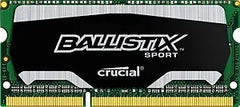 Currently Unavailable
Crucial BLS4G3N18AES4 4GB DDR3 1866MHz SODIMM Laptop Memory
Check on Amazon → ✓ Available
Crucial CT2K102464BF186D 16GB (2x8GB) DDR3L 1866MHz SODIMM
$78.90
View on Amazon → ✓ Available
Crucial CT51264BD186DJ 4GB DDR3 1866MHz Desktop Memory
View on Amazon →Frequently Asked Questions
What does 1866 MT/s actually mean for notebook performance, and is it noticeably faster than 1600 MT/s?
1866 MT/s (PC3-14900) represents a 16.6% increase in memory bandwidth over DDR3-1600. In practice, this translates to faster data throughput between RAM and the CPU — most noticeable in memory-bound workloads like browser multitasking, light photo editing, and background application handling. The delta over 1600 MT/s is real but modest; the bigger gain typically comes from adding capacity rather than speed alone.
Will this module work at 1866 MT/s in my notebook, or will it downclock to a lower speed?
The module is rated for 1866 MT/s, but your notebook's CPU memory controller determines the actual operating speed. If your platform only supports up to 1600 MT/s, the module will run at 1600 MT/s via XMP/JEDEC auto-negotiation — it will not cause instability, just not run at its rated speed. Check your CPU's supported memory speeds before purchasing if 1866 MT/s is critical.
What is the difference between the 1.35V and 1.5V voltage options on this module?
This is a dual-voltage DDR3L module — the "L" denotes low-voltage operation at 1.35V when the platform supports it. Notebooks with DDR3L-capable controllers will run the module at 1.35V, reducing power draw and heat generation. Systems that only support standard DDR3 at 1.5V will default to that voltage automatically. Dual-voltage design makes this module compatible with both DDR3 and DDR3L platforms.
Is 4GB still a viable upgrade in a modern workflow, or should I look for an 8GB module?
4GB is a meaningful upgrade for notebooks running at 2GB or using integrated graphics that share system RAM. For basic office tasks, web browsing, and light productivity, 4GB remains functional. For modern multitasking, development work, or any workflow involving more than a few browser tabs simultaneously, an 8GB module will deliver a more substantial long-term improvement if your system supports it.
Is this module compatible with Mac notebooks?
Crucial specifies this as a SODIMM for PC laptops and notebooks. Compatibility with Apple MacBook or MacBook Pro models requires verifying against Crucial's compatibility tool using your specific Mac model identifier — not all Apple notebooks use standard DDR3L JEDEC timing profiles.
Related Products


