



MSI
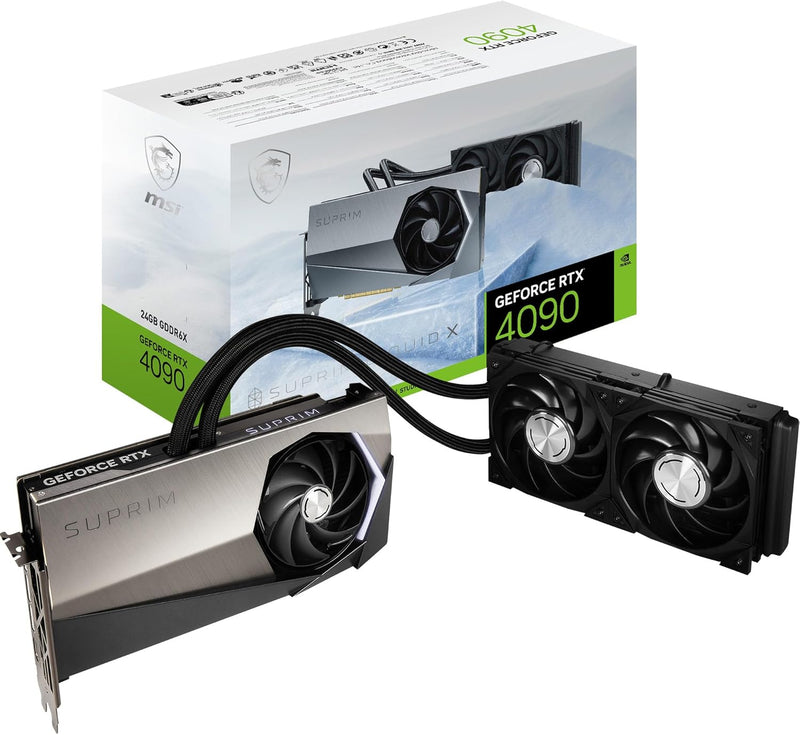
MSI V510-007R GeForce RTX 4090 SUPRIM Liquid X 24G Graphics Card
The RTX 4090 SUPRIM Liquid X's 2625MHz boost clock and 384-bit memory bus deliver the fastest rasterization and ray tracing currently available in consumer hardware.
$3,268.88*
View on Amazon
✓ In Stock on Amazon.com
*Price sourced from Amazon.com. Last updated:Sep 12, 2026.Price and availability are subject to change — details.
Affiliate Disclosure: As an Amazon Associate, Studio Supplies earns from qualifying purchases made through links on this page, at no additional cost to you. This helps support our editorial team.
Notice a mistake? Let Us Know
Overview
Key Features
Cutting-Edge GPUs NVIDIA Ada Lovelace architecture
brand: MSI
manufacturer: MSI COMPUTER
Specifications
GPU
NVIDIA GeForce RTX 4090
Architecture
NVIDIA Ada Lovelace
VRAM
24GB GDDR6X
Memory Bus
384-bit
Boost Clock
2625 MHz
TDP
450W
PCIe Interface
PCIe Gen 4 x16
Display Outputs
3x DisplayPort 1.4a, 1x HDMI 2.1a
Display Support
4K HDR, 8K HDR
Cooling
AIO Liquid (closed-loop)
Model
V510-007R
Similar Products
Other products from the same family that visitors often consider:
 Currently Unavailable
MSI RTX 4090 Gaming X Slim 24G GeForce Graphics Card
Check on Amazon → ✓ Available
MSI GeForce RTX 3090 SUPRIM X 24G Gaming Graphics Card
$1,619.99
View on Amazon → Currently Unavailable
MSI GeForce RTX 4090 GAMING X TRIO 24G OC Graphics Card
Check on Amazon → Currently Unavailable
MSI GeForce RTX 3090Ti SUPRIM X 24G Gaming Graphics Card
Check on Amazon → ✓ Available
MSI RTX 4090 GAMING SLIM 24G GDDR6X Graphics Card
$3,690.00
View on Amazon →Frequently Asked Questions
What cooling solution does the SUPRIM Liquid X use, and how does it differ from MSI's air-cooled RTX 4090 variants?
The SUPRIM Liquid X uses an all-in-one liquid cooling configuration — a closed-loop liquid cooler mounted directly to the GPU die — rather than the triple-fan air coolers on MSI's SUPRIM X and GAMING TRIO models. This allows the card to sustain its 2625MHz boost clock under extended full-load conditions with lower thermal variance, and it occupies only 2 PCIe slots in the chassis rather than the 3–4 slots required by large air-cooled 4090 designs.
What does the 384-bit memory bus mean for the RTX 4090's real-world bandwidth?
The 384-bit bus paired with GDDR6X memory delivers approximately 1,008GB/s of memory bandwidth on the RTX 4090. For workloads that are memory-bandwidth-limited — high-resolution texture rendering, large AI model inference, 8K video processing — this bus width is the specification that prevents the 24GB VRAM from becoming a throughput bottleneck.
What does the Liquid X cooling configuration provide versus standard air-cooled RTX 4090 designs?
The SUPRIM Liquid X uses a closed-loop liquid cooling system with a radiator external to the GPU bracket, allowing the GPU die to run significantly cooler under sustained load than triple-fan air designs. Lower sustained temperatures translate to longer boost clock maintenance — the GPU throttles less, meaning the 2625MHz boost is more consistently achievable across extended rendering or gaming sessions.
What power supply wattage is required to run this card?
NVIDIA recommends a minimum 850W PSU for RTX 4090 systems. The RTX 4090 has a 450W TDP, and the SUPRIM Liquid X variant runs at factory-overclocked clocks, so a 1000W or higher PSU is the practical recommendation for a full gaming system to maintain headroom under combined CPU and GPU load.
What display outputs does this card provide, and what resolutions does it support?
The SUPRIM Liquid X provides three DisplayPort 1.4a ports and one HDMI 2.1a port. DisplayPort 1.4a supports up to 8K at 60Hz or 4K at 144Hz; HDMI 2.1a supports 4K at 120Hz and 8K with DSC compression. The card is listed as supporting both 4K and 8K HDR output.
Does the RTX 4090 SUPRIM Liquid X require a PCIe Gen 5 slot, or does it work with Gen 4?
The card interfaces via PCI Express Gen 4, meaning it is compatible with current-generation Gen 4 motherboards without requiring a Gen 5 platform upgrade. Gen 5 x16 slots are backward compatible with PCIe Gen 4 cards.
What display outputs does the SUPRIM Liquid X provide?
The card provides three DisplayPort 1.4a outputs and one HDMI 2.1a output — a four-display maximum. HDMI 2.1a supports up to 10K resolution at 120Hz and 4K at 144Hz; DisplayPort 1.4a supports 4K at 144Hz and 8K at 60Hz with DSC compression.
Does this card support DLSS 3 and Frame Generation?
Yes. The RTX 4090 is based on NVIDIA's Ada Lovelace architecture, which includes the 4th-generation Tensor cores required for DLSS 3 Frame Generation. In supported games, DLSS 3 can multiply rendered framerates significantly beyond what raw rasterization performance alone provides.
What PCIe generation does this card require, and will it work in a PCIe 3.0 system?
The SUPRIM Liquid X uses a PCIe Gen 4 x16 interface. It is backward compatible with PCIe 3.0 motherboards, but you will see a bandwidth reduction — measurable in benchmarks but generally below 5% impact on gaming frame rates in most scenarios.
What power supply wattage is required for a system running the RTX 4090 SUPRIM Liquid X?
NVIDIA specifies a 850W minimum PSU for RTX 4090 configurations. MSI's SUPRIM variant with liquid cooling draws up to its TGP ceiling under sustained load — a 1000W or higher PSU is recommended for system stability in high-core-count CPU pairings, particularly during simultaneous CPU/GPU burst loading.
Related Products


