



QNAP
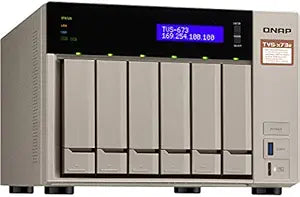
QNAP ASISP55 TVS-673e 64GB 4TB SSD 48TB HDD NAS
64GB DDR44TB SSD48TB HDDUSB 3.0
The QNAP TVS-673e pairs a quad-core AMD processor and 64GB DDR4 with 52TB of combined SSD/HDD storage to handle virtualization, surveillance, and file serving simultaneously without compromise.
$4,259.00*
View on Amazon
✓ In Stock on Amazon.com
*Price sourced from Amazon.com. Last updated:Aug 28, 2026.Price and availability are subject to change — details.
Affiliate Disclosure: As an Amazon Associate, Studio Supplies earns from qualifying purchases made through links on this page, at no additional cost to you. This helps support our editorial team.
Notice a mistake? Let Us Know
Overview
Key Features
QNAP Turbo NAS TVS-673e is a high-performance, versatile and energy-efficient 6 bay tower storage system for small businesses and remote offices
Access all of the features of your NAS including applications, multimedia content, cross-platform file sharing, host virtual machines, convert and store files, create your own surveillance station, and much more with QNAP QTS 4.3 operating system
Expand your storage and connectivity options with 4 x USB 3.0, 2 x HDMI, 4 x 1GbE (RJ-45) Ports; Get powerful performance with AMD RX-421BD Quad-Core 2.1GHz processor; Multitask with ease with 64GB DDR4 memory; Store plenty of data with 4TB (2 x 2TB) SSDs for ultra fast storage and 48TB (6 x 8TB) SATA HDDs for high capacity storage
QNAP NAS chassis comes in a sealed box.
Hard drives and memory upgrades included separately NOT installed, installation required.
Specifications
Brand
QNAP
Model
ASISP55 / TVS-673e
Form Factor
Tower, 6-Bay + 2 PCIe M.2 Slots
Processor
AMD RX-421BD Quad-Core 2.1GHz (Turbo 3.4GHz)
RAM
64GB DDR4 PC4-19200 2400MHz SODIMM
SSD Storage
4TB (2 x 2TB M.2 Solid State Drives)
HDD Storage
48TB (6 x 8TB 6Gb/s SATA 3.5")
Graphics
Embedded AMD Radeon R7
Network Ports
4 x 1GbE (RJ-45)
USB Ports
4 x USB 3.0
Display Ports
2 x HDMI
Operating System
QNAP QTS 4.3
ASIN
B08586WWB3
Similar Products
Other products from the same family that visitors often consider:
 ✓ Available
QNAP ASISP52 TVS-673e NAS 6TB HDD 512GB SSD
$1,779.00
View on Amazon → ✓ Available
QNAP TS877P NAS - Ryzen 5, 64GB, 2TB SSD, 24TB HDD
$3,799.00
View on Amazon → ✓ Available
QNAP TS877P Ryzen 7 64GB RAM 24TB HDD NAS Server
$4,249.00
View on Amazon → ✓ Available
QNAP ASISP56 TVS-473e NAS 8GB 4TB SSD Storage
$1,699.00
View on Amazon →Frequently Asked Questions
Do the hard drives and SSDs come pre-installed?
No. The TVS-673e chassis ships sealed, with the 4TB SSDs (2 x 2TB M.2) and 48TB HDDs (6 x 8TB SATA) listed in this bundle included separately and requiring installation. Physical drive installation is required before first use — QNAP's QTS setup wizard guides volume configuration after drives are seated.
What processor powers this NAS and what does that mean for multitasking workloads?
The AMD RX-421BD is a quad-core APU clocked at 2.1GHz with a 3.4GHz turbo. It is an x86 processor, which matters significantly — x86 architecture enables native virtual machine hosting, Docker container execution, and full application compatibility on QTS 4.3. ARM-based NAS units cannot match this for running simultaneous services like a surveillance station, file sharing, and a hosted VM concurrently.
What is the purpose of having both M.2 SSDs and SATA HDDs in this configuration?
The 4TB of M.2 SSD storage (2 x 2TB) is suited for high-IOPS workloads — database caches, VM storage, or Qtier auto-tiering where hot data is promoted to flash. The 48TB of SATA HDD capacity handles bulk storage, backup targets, and archival data. Running both tiers simultaneously allows QTS's Qtier to automatically migrate frequently accessed files to SSD and cold data to HDD, optimizing both performance and cost-per-gigabyte.
How many simultaneous 4K video streams can the embedded Radeon R7 GPU handle for transcoding?
The AMD RX-421BD's embedded Radeon R7 graphics support hardware-accelerated transcoding in QNAP's multimedia applications. Actual concurrent 4K stream count depends on codec (H.264 vs H.265), target bitrate, and whether transcoding or direct play is used — QNAP's Plex and Video Station apps leverage this GPU for hardware acceleration, but the embedded GPU is not intended for heavy parallel transcoding workloads typical of a dedicated media server.
Is 64GB of RAM upgradeable, and what are the expansion options?
The 64GB DDR4 configuration uses SODIMM slots. Whether this specific bundle's configuration represents the maximum supported capacity should be verified against QNAP's official TVS-673e memory compatibility list. Additionally, the TVS-673e includes PCIe expansion slots, allowing 10GbE networking or NVMe expansion cards to be added as workload demands grow.
Related Products
