



Synology
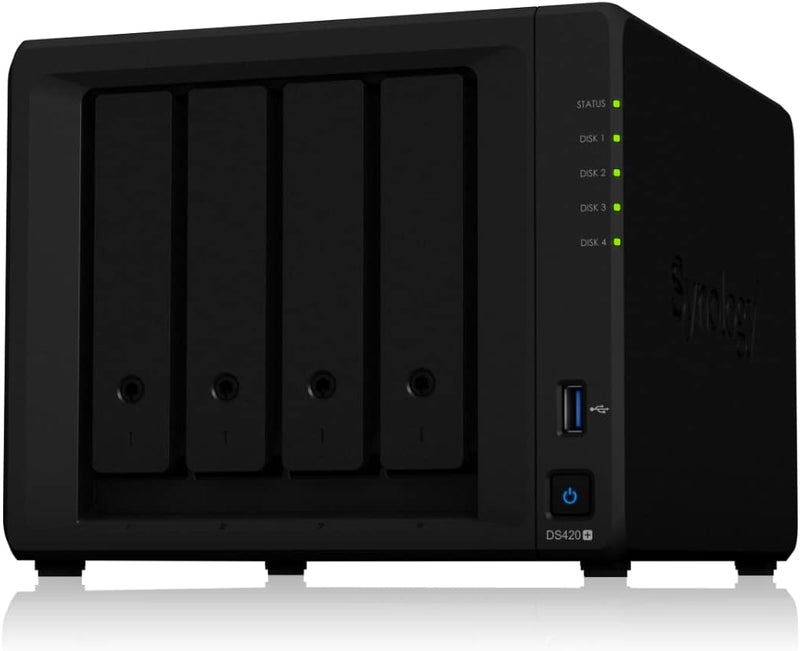
Synology DS420+ 4-Bay NAS DiskStation (Diskless)
2 GB DDR4
Dual M.2 NVMe cache slots and a 226 MB/s Intel-backed throughput ceiling make the DS420+ the serious starting point for a home or small-office NAS.
$999.99*
View on Amazon
✓ In Stock on Amazon.com
*Price sourced from Amazon.com. Last updated:Oct 23, 2026.Price and availability are subject to change — details.
Affiliate Disclosure: As an Amazon Associate, Studio Supplies earns from qualifying purchases made through links on this page, at no additional cost to you. This helps support our editorial team.
Notice a mistake? Let Us Know
Overview
Key Features
Two built-in M.2 2280 NVMe SSD slots permit cache acceleration without occupying storage drive bays.
Intel dual-core processor with AES-NI hardware encryption engine; over 226 MB/s sequential read and 225 MB/s sequential write throughput.
2 GB DDR4 memory (expandable up to 6 GB)
Average 15% performance boost to photo indexing and other computing-intensive operations, as well as database response time.
By default, two camera licenses are installed; extra licenses can be purchased (CLP1, CLP4, or CLP8)
Specifications
Drive Bays
4 (3.5" / 2.5" SATA)
M.2 SSD Slots
2 x M.2 2280 NVMe (cache only)
Processor
Intel Dual-Core with AES-NI hardware encryption
Memory
2 GB DDR4 (expandable to 6 GB)
Sequential Read Throughput
>226 MB/s
Sequential Write Throughput
>225 MB/s
Storage Interface
SATA
Operating System
Synology DiskStation Manager (DSM)
Camera Licenses (included)
2 (expandable via CLP1, CLP4, CLP8)
Similar Products
Other products from the same family that visitors often consider:
 Currently Unavailable
Synology DS413 DiskStation 4-Bay NAS (Diskless)
Check on Amazon → ✓ Available
Synology DS423 4-Bay DiskStation NAS (Diskless)
$349.99
View on Amazon → Currently Unavailable
Synology DS418 DiskStation 4-Bay NAS (Diskless)
Check on Amazon → Currently Unavailable
Synology DS923+ 4-Bay DiskStation NAS (Diskless)
Check on Amazon → Currently Unavailable
Synology DS423+ 4-Bay NAS DiskStation
Check on Amazon →Frequently Asked Questions
What drives do I need to buy, and how many does the DS420+ support?
The DS420+ ships diskless — no hard drives included. It accepts up to four 3.5" or 2.5" SATA drives in its main bays. Drive selection depends on your capacity and redundancy needs; Synology publishes a compatibility list, and drives on that list are validated for reliable operation under DSM.
What does the M.2 NVMe SSD cache actually do for performance?
The two M.2 2280 NVMe slots are dedicated to SSD cache acceleration — they accelerate read and write access to frequently accessed data by serving as a fast buffer in front of the slower spinning drives. Critically, they do not occupy any of the four drive bays, so you get cache performance without sacrificing storage capacity.
Can I expand the memory beyond 2GB?
Yes — the DS420+ ships with 2GB DDR4 but is expandable to 6GB. A RAM upgrade meaningfully improves performance for memory-intensive workloads like running multiple Docker containers, virtual machines, or heavy Synology Photos indexing.
What is the real-world sequential throughput, and what limits it?
Synology rates the DS420+ at over 226 MB/s sequential read and 225 MB/s sequential write. The bottleneck in most home setups is the 1GbE network interface, which caps practical throughput at ~125 MB/s — to approach the rated speeds, a 2.5GbE or 10GbE network adapter upgrade or direct USB 3.0 transfer is needed.
Does the DS420+ support surveillance camera recording out of the box?
Yes — two Surveillance Station camera licenses are included by default. Additional licenses are available as CLP1, CLP4, or CLP8 packs for expanding beyond two cameras.
Related Products
