



Price history
Acer
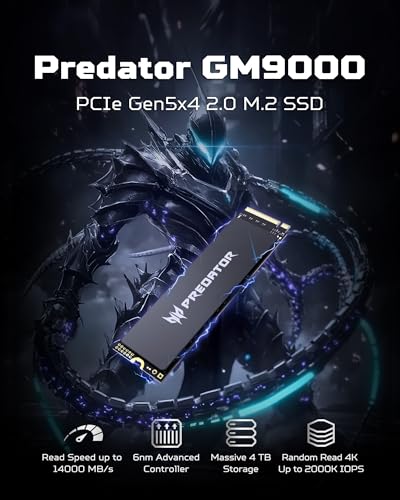
Acer Predator GM9000 PCIe Gen5 NVMe SSD
Acer's Predator GM9000 chases PCIe Gen5 speed with up to 14,000MB/s reads and a dual SLC-plus-DRAM cache in a 2TB M.2 drive
$450.99*
View on Amazon
✓ In Stock on Amazon.com
*Price sourced from Amazon.com. Last updated:Aug 09, 2026.Price and availability are subject to change.
Affiliate Disclosure: Studio Supplies may earn a commission from qualifying purchases made through links on this page, at no additional cost to you. This helps support our editorial team.
Notice a mistake? Let Us Know
Overview
Key Features
Upgraded Performance: PCIe 5.0 SSD has performance doubled compared to PCIe 4.0. It delivers blazing-fast speed, a maximum read speed of 14000 MB/s and a maximum write speed of 13000 MB/s.
Specifications
Brand
Acer
Manufacturer
BIWIN
Model
Predator GM9000
Capacity
2TB
Interface
PCIe Gen5x4 NVMe (PCIe 5.0)
Form Factor
M.2
Max Read Speed
Up to 14,000MB/s
Max Write Speed
Up to 13,000MB/s
Cache
SLC + DRAM
Compatibility
Desktops, laptops, PC AI work
Frequently Asked Questions
Do I need a PCIe 5.0 motherboard to reach the GM9000's rated speeds?
Yes. The advertised 14,000MB/s read and 13,000MB/s write speeds require a PCIe Gen5x4 M.2 slot. On PCIe 4.0 or 3.0 systems the drive still works but is capped at that slower interface's limits.
How fast is the Acer Predator GM9000?
Acer rates it at up to 14,000MB/s sequential read and up to 13,000MB/s sequential write, which the company describes as roughly double the performance of the prior PCIe 4.0 generation.
What capacity does this GM9000 model offer?
This listing is the 2TB version, offering ample space for large game libraries, high-resolution media projects, and AI datasets on a single M.2 drive.
What does the SLC plus DRAM cache do on the GM9000?
The dual-cache design pairs an SLC cache with a DRAM cache to help sustain transfer speeds during longer, heavier workloads rather than slowing sharply once a small buffer is filled.
Will the GM9000 fit both desktops and laptops?
Acer lists it as compatible with desktops and laptops using the M.2 form factor. Confirm your device has an M.2 NVMe slot, and ideally a PCIe 5.0 one, to get the most from the drive.
Related Products


