



ASRock
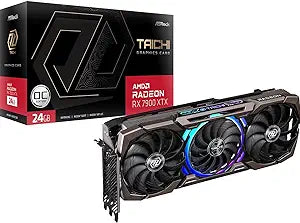
ASRock RX7900XTX TC 24GO AMD Radeon Taichi Graphics Card
The RX 7900 XTX's 96 compute units and 384-bit memory bus at 20 Gbps put 4K gaming and GPU compute workloads within reach of enthusiast budgets.
$1,299.22*
View on Amazon
✓ In Stock on Amazon.com
*Price sourced from Amazon.com. Last updated:Sep 13, 2026.Price and availability are subject to change — details.
Affiliate Disclosure: As an Amazon Associate, Studio Supplies earns from qualifying purchases made through links on this page, at no additional cost to you. This helps support our editorial team.
Notice a mistake? Let Us Know
Overview
Key Features
Flagship 4K/8K Gaming Performance: AMD Radeon RX 7900 XTX GPU with 24GB GDDR6 memory on 384-bit bus delivers exceptional gaming and content creation performance
Advanced RDNA 3 Architecture: 96 Compute Units with Ray Tracing and AI Accelerators, plus 96MB AMD Infinity Cache for cutting-edge gaming technology
Extreme Clock Speeds: Boost clock up to 2680 MHz and game clock of 2510 MHz with 20 Gbps memory speed for ultimate gaming performance
Premium Taichi Cooling System: Triple 110/100/110mm striped ring fans with advanced heatsink design and reinforced metal frame for optimal thermal performance
Advanced Power Delivery: 22 power phase design with triple 8-pin power connectors ensures stable power for extreme overclocking and sustained performance
Dual BIOS Functionality: Switch between performance and quiet BIOS profiles to match your usage scenario and acoustic preferences
Stunning ARGB Lighting: Polychrome SYNC compatible ARGB backplate with customizable lighting effects for personalized system aesthetics
Next-Gen Display Connectivity: Three DisplayPort 2.1 and one HDMI 2.1 outputs support high-resolution, high-refresh-rate displays up to 8K
Massive Memory Configuration: 24GB GDDR6 memory with 384-bit interface provides ample bandwidth for 4K gaming and professional workloads
Dedicated Support: Contact us directly through Amazon for any product questions or assistance
Specifications
GPU Model
AMD Radeon RX 7900 XTX
Brand
ASRock
Series
Taichi
VRAM
24GB
Cooling System
Taichi 3X Cooling System
Backplate
ARGB Backplate
Frame
Reinforced Metal Frame
BIOS
Dual BIOS
Lighting
Polychrome SYNC
Similar Products
Other products from the same family that visitors often consider:
 ✓ Available
ASRock RX7900XTX PG 24GO Radeon Phantom Gaming 24GB
$1,289.00
View on Amazon → ✓ Available
ASRock RX6400 CLI 4G Radeon Graphics Card
$129.99
View on Amazon → ✓ Available
ASRock RX6900XT OCF 16G Radeon Graphics Card
$985.00
View on Amazon → ✓ Available
ASRock RX6500XT PGD 4GO Radeon Graphics Card
$214.96
View on Amazon → Currently Unavailable
ASRock RX7800XT SL 16GO Radeon Graphics Card
Check on Amazon →Frequently Asked Questions
What GPU architecture does the RX7900XTX TC 24GO use, and what does that mean for performance?
It runs AMD's RDNA 3 architecture with 96 compute units. RDNA 3 introduced chiplet-based GPU design with dual-issue shader execution, meaning the compute unit count translates to more effective shader throughput per clock than the same CU count on RDNA 2. Combined with a boost clock of up to 2,680 MHz, this is one of the highest-performing GPU configurations AMD has shipped.
What memory configuration does this card use and how does that affect bandwidth?
The card carries 24GB of GDDR6 on a 384-bit memory bus running at 20 Gbps. That yields approximately 960 GB/s of theoretical memory bandwidth. At 4K resolution, where large texture sets and frame buffers stress memory bandwidth, this is a meaningful advantage over narrower-bus configurations.
What display outputs are available on this card?
The RX7900XTX TC 24GO provides three DisplayPort 2.1 outputs and one HDMI 2.1 output. DisplayPort 2.1 supports up to 80 Gbps bandwidth — enough for 4K 240Hz, 8K 60Hz, or multi-monitor setups at high refresh rates. HDMI 2.1 covers 4K 144Hz and 8K connections to compatible TVs or monitors.
What power connectors are required, and what PSU wattage is recommended?
The card requires three 8-pin power connectors. The RX 7900 XTX has a rated board power of around 355W under load — AMD and AIB partners typically recommend a minimum 850W PSU, with 1000W suggested for overclocked configurations like the Taichi OC to maintain headroom for the rest of the system.
What does Dual BIOS on this card allow?
Dual BIOS provides two separate firmware chips. The secondary BIOS typically stores a more conservative clock profile, allowing you to recover from a failed primary BIOS flash or test different power and clock configurations with the ability to revert by switching to the backup chip without a recovery procedure.
Related Products


