



MSI
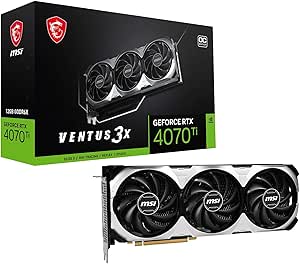
MSI GeForce RTX 4070 Ti VENTUS 3X 12G OC Graphics Card
7680 x 4320DisplayPortHDMI 2.1
The RTX 4070 Ti VENTUS 3X hits 2655 MHz boost on Ada Lovelace silicon with triple-fan cooling — 4K gaming performance without the flagship GPU price tag.
$1,245.00*
View on Amazon
✓ In Stock on Amazon.com
*Price sourced from Amazon.com. Last updated:Sep 12, 2026.Price and availability are subject to change — details.
Affiliate Disclosure: As an Amazon Associate, Studio Supplies earns from qualifying purchases made through links on this page, at no additional cost to you. This helps support our editorial team.
Notice a mistake? Let Us Know
Overview
Key Features
Chipset: GeForce RTX 4070 Ti
Video Memory: 12GB GDDR6X
Memory Interface: 192-bit
Output: DisplayPort x 3 (v1.4a) / HDMI 2.1 x 1
Digital maximum resolution: 7680 x 4320
Specifications
GPU Chipset
GeForce RTX 4070 Ti
Video Memory
12GB GDDR6X
Memory Interface
192-bit
DisplayPort Outputs
3 (v1.4a)
HDMI Outputs
1 (2.1)
Maximum Digital Resolution
7680 x 4320
Similar Products
Other products from the same family that visitors often consider:
 Currently Unavailable
MSI GeForce RTX 4070 Ti VENTUS 3X 12G OC Graphics Card
Check on Amazon →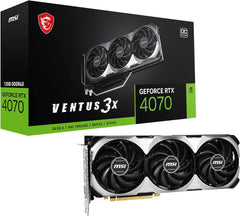 ✓ Available
MSI GeForce RTX 4070 VENTUS 3X 12G OC Graphics Card
$1,095.00
View on Amazon →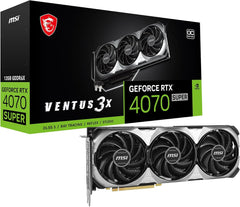 Currently Unavailable
MSI GeForce RTX 4070 SUPER 12G VENTUS 3X OC Graphics Card
Check on Amazon → ✓ Available
MSI GeForce RTX 3060 Ventus 3X 12G OC Graphics Card
$630.00
View on Amazon →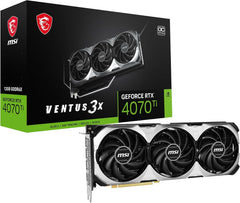 Currently Unavailable
MSI RTX 4070 Ti VENTUS 3X OC Graphics Card
Check on Amazon →Frequently Asked Questions
What does the Ada Lovelace architecture deliver for the RTX 4070 Ti versus previous-generation Ampere GPUs?
Ada Lovelace brings fourth-generation Tensor Cores and third-generation RT (Ray Tracing) Cores to the 4070 Ti. The Tensor Core generation matters specifically for DLSS 3 Frame Generation — Ada can generate entirely new frames using AI interpolation, not just upscale existing ones as DLSS 2 did. In supported titles, DLSS 3 Frame Generation effectively doubles the perceived frame rate on top of DLSS upscaling. The RT Core improvements reduce ray tracing performance costs compared to Ampere, enabling higher-fidelity lighting at competitive frame rates.
Will the RTX 4070 Ti VENTUS 3X fit in my PC case, and what power connector does it require?
The VENTUS 3X is a triple-slot card; confirm your case has three available PCIe slot positions with adequate clearance. The card uses a 16-pin (12VHPWR) power connector — MSI includes adapters for standard 8-pin PCIe connections, so existing power supplies with conventional PCIe power connectors can be used. A 700W power supply is the minimum practical recommendation; 750W+ is advised for system stability under sustained load with a modern CPU.
Is 12GB of GDDR6X enough VRAM for 4K gaming and content creation in 2024?
For the majority of 4K gaming titles at high settings, 12GB GDDR6X is sufficient — most current games at 4K with standard texture packs operate within a 10–11GB VRAM budget. The edge cases where 12GB becomes a constraint are titles with very large texture packs, modded games with high-resolution texture replacements, and certain AI-accelerated workflows that stage large model weights in VRAM. For content creation — video encoding, 3D rendering — 12GB handles most professional workloads at 4K, though some complex multi-layer compositing scenes can exceed this.
What does the 192-bit memory bus width mean for real-world performance?
The 192-bit bus width determines how much data can move between the GDDR6X memory and the GPU's shader cores per clock cycle. Combined with GDDR6X's high per-pin bandwidth, the 192-bit bus delivers approximately 504 GB/s of memory bandwidth on the 4070 Ti. For reference, the RTX 3080 offered 320 GB/s over a 320-bit bus — the 4070 Ti's narrower but faster GDDR6X configuration partially closes that gap, but at the most demanding 4K settings and resolutions, the bus width advantage of wider alternatives (like the RTX 4080's 256-bit bus) remains measurable.
How loud does the VENTUS 3X cooling run under full load, and does it idle silently?
MSI's TORX Fan 4.0 triple-fan configuration on the VENTUS 3X supports zero-RPM idle — all three fans stop completely when the GPU is below ~60°C, meaning the card is completely silent during desktop use, video playback, and light gaming. Under sustained 4K gaming load, the fans spin up to maintain temperatures in the 70–80°C range; at load, noise output is moderate — audible but not aggressive compared to dual-fan alternatives pushing the same thermal envelope.
Related Products


