



MSI
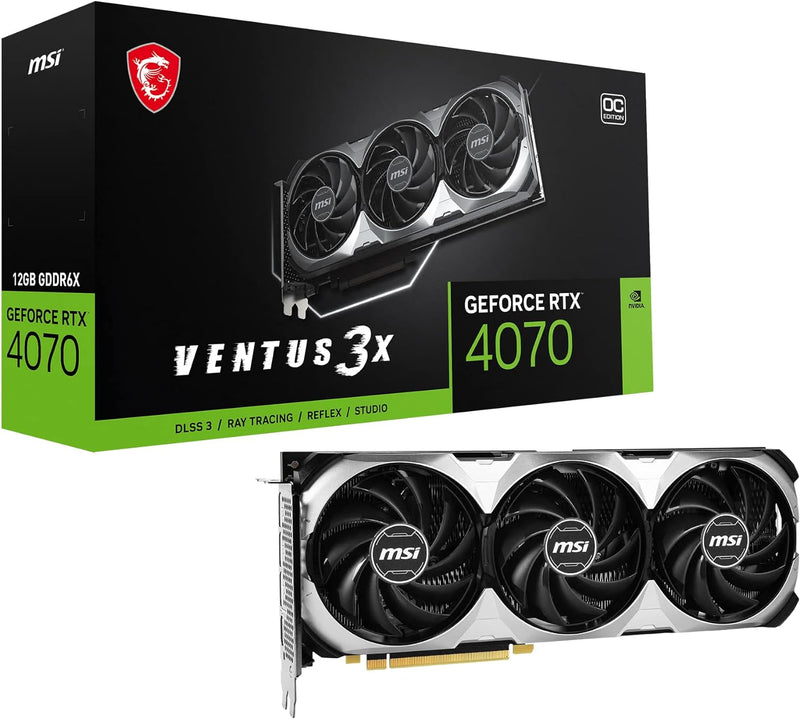
MSI GeForce RTX 4070 VENTUS 3X 12G OC Graphics Card
7680 x 4320DisplayPortHDMI 2.1
Ada Lovelace architecture and 12GB GDDR6X at 2520MHz boost clock — the RTX 4070 VENTUS 3X OC delivers next-gen rasterization and DLSS 3 frame generation without the flagship price tag.
$1,095.00*
View on Amazon
✓ In Stock on Amazon.com
*Price sourced from Amazon.com. Last updated:Sep 12, 2026.Price and availability are subject to change — details.
Affiliate Disclosure: As an Amazon Associate, Studio Supplies earns from qualifying purchases made through links on this page, at no additional cost to you. This helps support our editorial team.
Notice a mistake? Let Us Know
Overview
Key Features
Chipset: GeForce RTX 4070
Video Memory: 12GB GDDR6X
Memory Interface: 192-bit
Output: DisplayPort x 3 (v1.4a) / HDMI 2.1 x 1
Digital maximum resolution: 7680 x 4320
Specifications
Brand
MSI
Model
GeForce RTX 4070 VENTUS 3X 12G OC
Chipset
GeForce RTX 4070
Architecture
NVIDIA Ada Lovelace
Video Memory
12GB GDDR6X
Memory Interface
192-bit
Boost Clock
2520 MHz
Outputs
3x DisplayPort 1.4a, 1x HDMI 2.1
Maximum Resolution
7680 x 4320 (8K)
Cooling
TORX Fan 4.0 (Triple Fan)
ASIN
B0BZB6WJZJ
Similar Products
Other products from the same family that visitors often consider:
 ✓ Available
MSI GeForce RTX 4070 Ti VENTUS 3X 12G OC Graphics Card
$1,245.00
View on Amazon → Currently Unavailable
MSI GeForce RTX 4070 Ti VENTUS 3X 12G OC Graphics Card
Check on Amazon → Currently Unavailable
MSI GeForce RTX 4070 SUPER 12G VENTUS 3X OC Graphics Card
Check on Amazon → ✓ Available
MSI GeForce RTX 3060 Ventus 3X 12G OC Graphics Card
$630.00
View on Amazon → ✓ Available
MSI RTX 3060 Ventus 3X 12G OC Gaming Graphics Card
$387.22
View on Amazon →Frequently Asked Questions
What does the 192-bit memory bus mean for this card's performance relative to the RTX 4080's 256-bit bus?
The 192-bit memory bus limits peak memory bandwidth to roughly 504 GB/s on the RTX 4070 versus ~717 GB/s on the RTX 4080. In practice, this means the 4070 is more constrained in memory-bandwidth-heavy workloads — 4K texture streaming, high-resolution rendering, and certain compute tasks will hit this ceiling before the 4080 does. At 1440p and below, the bandwidth difference is largely masked by the 4070's efficient Ada Lovelace architecture.
Does the VENTUS 3X OC edition run hotter or louder than reference RTX 4070 designs?
The VENTUS 3X uses MSI's TORX Fan 4.0 triple-fan cooling array, which keeps junction temperatures below 80°C under sustained gaming load in most mid-tower cases with adequate airflow. Fan noise at load is moderate — audible under full stress but not objectionable in typical gaming environments. The OC boost clock of 2520MHz versus the reference 2475MHz is a minor 45MHz overclock that does not meaningfully increase thermals.
Will this card bottleneck at 4K gaming given the 192-bit memory interface?
At 4K with maximum texture quality settings, the RTX 4070 is a capable but not unlimited performer — frame rates in demanding titles typically land in the 50–70 fps range without DLSS. With DLSS 3 Quality mode enabled, 4K gaming becomes fluid and the memory bandwidth constraint is substantially mitigated. For native 4K without upscaling, the RTX 4080 or 4090 is the technically correct choice.
How many monitors can this card drive simultaneously, and at what maximum resolution?
The VENTUS 3X supports up to four simultaneous displays via its three DisplayPort 1.4a outputs and one HDMI 2.1 output. Maximum digital resolution is 7680x4320 (8K). HDMI 2.1 supports 4K120 and 8K60 with DSC compression.
Is a power supply upgrade required to run this card in an existing mid-range build?
The RTX 4070 has a 200W TDP and typically requires a 650W PSU minimum. The VENTUS 3X uses a single 16-pin (12VHPWR) connector. If your current build is running a 550W or lower PSU, an upgrade is strongly recommended. The 16-pin adapter is included in the box for systems with standard 8-pin PCIe connectors.
Related Products


