
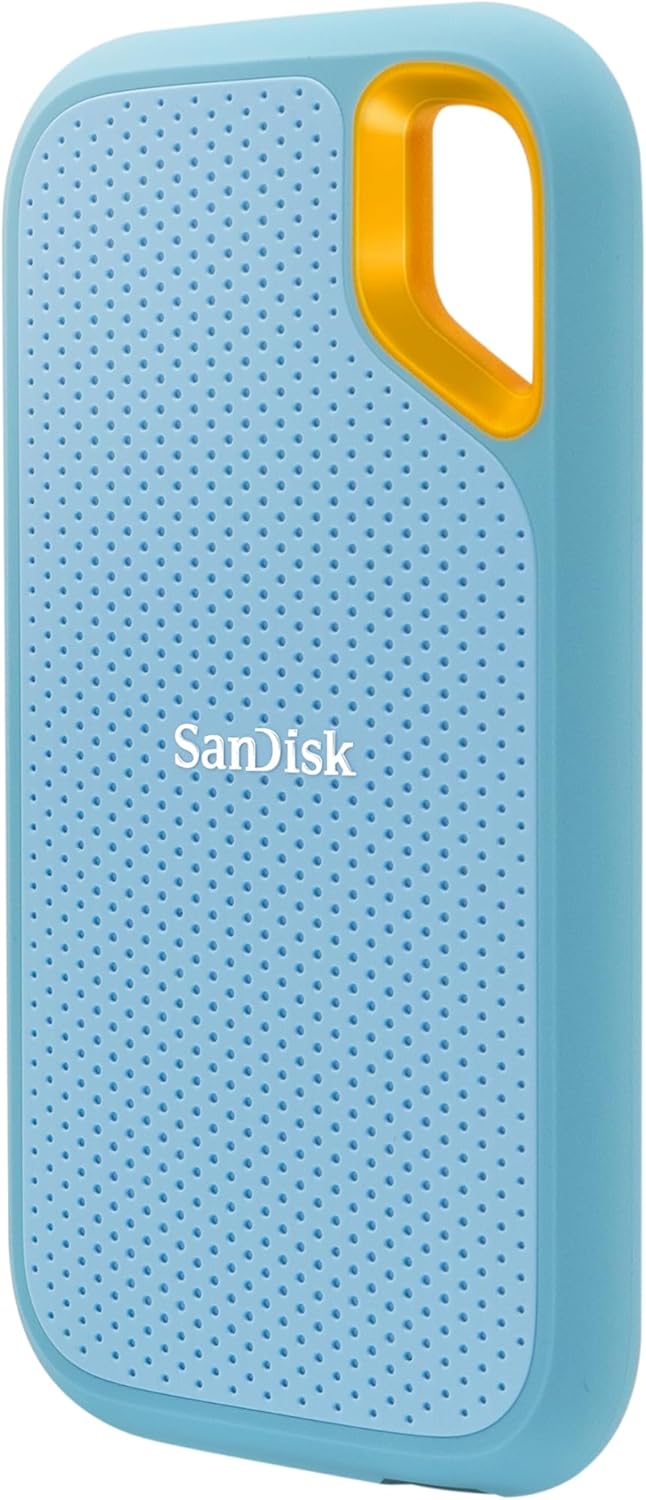


SanDisk Extreme Portable SSD V2 4TB (SDSSDE61-4T00-G25B) — Benchmarks, Firmware History & Workload Fit
The SanDisk Extreme Portable SSD V2 (SDSSDE61-4T00-G25B) is the 4 TB Sky Blue variant of SanDisk's Gen-2 USB 3.2 Gen 2 portable SSD, rated 1,050 MB/s sequential read and 1,000 MB/s sequential write over a 10 Gbps USB-C interface. Per SanDisk / Western Digital's product page, the drive carries IP65 dust and water resistance, 3-meter drop protection, and a 5-year limited warranty. This benchmark module covers Tom's Hardware's tested performance numbers, the 2023 4 TB firmware-and-hardware-issue history (which buyers must know about), and the workload fit profile.
Tom's Hardware Benchmark Findings
Tom's Hardware's SanDisk Extreme v2 Portable SSD review measured sequential performance close to the rated 1,050/1,000 MB/s ceiling over USB 3.2 Gen 2's 10 Gbps interface. The publication specifically called out that the Extreme V2 delivered faster sustained write speeds than Western Digital's My Passport portable SSD by roughly 100 MB/s on average. Tom's also documented the static SLC cache behavior: once the on-drive SLC cache is exhausted, sustained writes degrade to direct-to-TLC speeds — a typical pattern for the consumer portable SSD class. For workloads where total writes fit within the SLC cache window (most consumer file-transfer scenarios), the drive runs at its rated speed. For multi-hundred-GB sustained writes (large project archives, multi-hour 4K capture offloads), the post-cache slowdown is expected.
Real-World Throughput in Practical Terms
The 1,050 MB/s rated read is approximately 2x what a portable HDD delivers and approximately 6-7x what USB 2.0 ceilings allow. For typical creator workflows the difference manifests as:
- Offloading a 200 GB 4K project folder: ~3-4 minutes versus 30+ minutes on a portable HDD
- Booting a portable OS (macOS, Windows-To-Go, Linux Live): Comparable to many internal SSDs; the USB 3.2 Gen 2 bus is the limiter
- Direct-record from a USB-C cinema camera or recorder: 1,000 MB/s sustained write is well above any consumer cinema-camera write demand at 4K/6K bitrates
- Game-library secondary storage (Steam library / PS5 supplemental): Game load times for many titles fall within range of internal NVMe SSD performance over this bus
2023 Firmware and Hardware Issue — What Buyers Need to Know
This SKU's class (4 TB Extreme V2 and 4 TB Extreme Pro V2) was the subject of a well-publicized 2023 reliability issue cluster. Tom's Hardware's reporting on the issue documented multiple cases of sudden data loss and drive unreadability on 4 TB Extreme and Extreme Pro V2 models. Western Digital acknowledged the reports and released a firmware update for 4 TB drives. A subsequent investigation by data-recovery firm Attingo, covered by Tom's Hardware, identified two hardware-side contributors: oversized components making weak contact with PCB pads, and defective solder joints with internal voids that fail under thermal cycling. Tom's Hardware's coverage of the resulting class-action lawsuit reports that some firmware-updated and replacement drives subsequently exhibited similar failures.
What this means for buyers in 2026:
- Run the latest firmware. Western Digital's firmware update tool is at support-en.sandisk.com/app/firmwareupdate; check it on first plug-in and after any major OS upgrade
- Treat the drive as a working copy, not a sole copy. Any portable SSD — regardless of brand — is mechanically and electronically vulnerable; the 3-2-1 backup principle (3 copies, 2 different media types, 1 offsite) applies. The 4 TB Extreme V2 history makes this discipline non-optional for this specific SKU
- The 5-year warranty is the remediation channel. SanDisk / Western Digital honors the limited warranty on this drive; in the event of a failure, the warranty replacement path remains available
Where the 4TB Extreme V2 Specifically Fits
- Creator workflow secondary storage — offload destination for completed 4K/6K projects, photo library overflow, music production session archives. A working copy that sits on the desk or in the bag and is paired with cloud sync (Backblaze, Dropbox, iCloud) or NAS sync for the primary copy
- Field-capture target for action cameras / cinema cameras — direct USB-C record from supporting cameras (DJI Osmo Pocket 3, Atomos Ninja recorders, Blackmagic recorders with USB-C output) where the sustained-write rating covers all consumer-tier 4K/6K bitrate profiles
- Console game library expansion — supplemental drive for PS5 / PS4 / Xbox Series X library overflow. The drop and IP65 protection make the drive less fragile than typical desktop USB-HDD console expansion options
- Portable bootable OS for technicians — macOS, Windows-To-Go, or Linux live images that run from the drive at internal-SSD-comparable speeds
Where Buyers Should Look Elsewhere
- Users who cannot tolerate the historical firmware/hardware risk profile on this SKU should consider Samsung T7 / T9 portable SSD (no equivalent reliability cluster documented) or Crucial X9 Pro / X10 Pro portable SSD — competing options in the same price class with cleaner reliability histories
- Cinema professionals requiring V-Mount or specialized professional connector integration — the consumer USB-C portable SSD class is the wrong tier; look at OWC Envoy Pro, Sabrent Rocket XTRM, or in-camera CFexpress workflows
- Cold archival storage — portable SSDs are designed for active working-copy use; long-term cold storage (drives written then shelved for years) is better served by tape or by consumer external HDDs in offsite rotation
- NAS-attached storage — portable SSDs are single-user-attached. Multi-user simultaneous access requires NAS-class drives (Seagate IronWolf, WD Red Plus) in an enclosure
Honest Cons Summary
- The 2023 4 TB reliability cluster is documented and material. Per Tom's Hardware, this specific capacity tier (4 TB Extreme V2 and Pro V2) had the most reported failures. Buyers should plan around it with backup discipline
- Sustained-write post-cache slowdown is real (per Tom's Hardware methodology) but typical for the consumer portable SSD class. Pro-class workflows requiring sustained 1,000 MB/s write through multi-TB transfers need a Thunderbolt 3/4 portable SSD instead (OWC Envoy Pro, SanDisk Pro-Blade)
- USB 3.2 Gen 2 (10 Gbps) bus is the ceiling. The drive cannot exceed ~1,050 MB/s regardless of host capability. Thunderbolt 3/4 portable SSDs (~2,800 MB/s) are the next-tier upgrade
- 4 TB is the capacity-per-cost premium tier. The 2 TB Extreme V2 is materially cheaper per GB; buyers without a specific 4 TB need should consider doubling-up on 2 TB units for diversification
Sources & Citations
- SanDisk / Western Digital, "SanDisk Extreme Portable SSD V2 product page (SDSSDE61-4T00-G25)," westerndigital.com (accessed 2026-05-17)
- Tom's Hardware, "SanDisk Extreme v2 Portable SSD Review: Twice the Speed, Better Security," tomshardware.com (accessed 2026-05-17)
- Tom's Hardware, "SanDisk Extreme Portable SSD Suffer Sudden Failures: WD Responds," tomshardware.com (accessed 2026-05-17)
- Tom's Hardware, "SanDisk Extreme Pro Failures Result From Design and Manufacturing Flaws, Says Data Recovery Firm," tomshardware.com (accessed 2026-05-17)
- Tom's Hardware, "WD's SSD Failures Stoke Class Action Lawsuit Over SanDisk Extreme Pro," tomshardware.com (accessed 2026-05-17)
- SanDisk Support, "Firmware Updates for SanDisk & WD Portable SSDs," support-en.sandisk.com (accessed 2026-05-17)
Last verified: 2026-05-17


